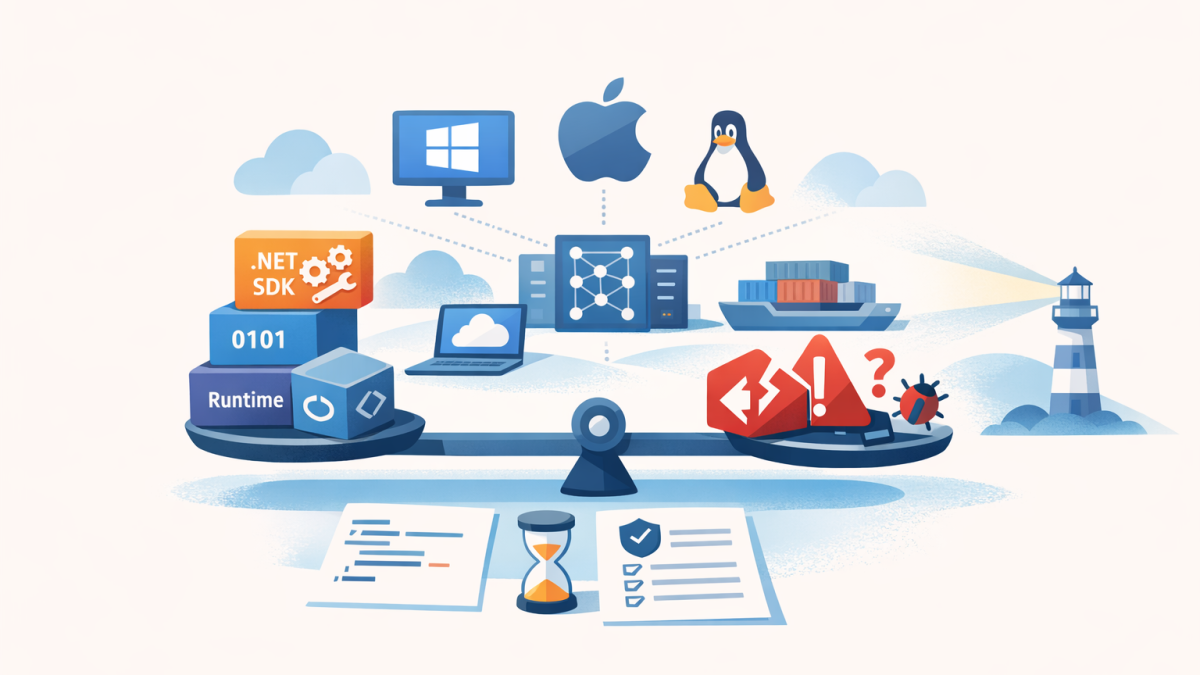
In this blog post dotnetup and the New Direction for .NET SDK Management in 2026 we will look at why .NET SDK management is becoming a board-level engineering reliability issue, not just a developer convenience problem.
One pattern I keep running into with enterprise .NET environments is simple on the surface but expensive underneath. The application is modern, the cloud platform is mature, the DevOps pipeline looks clean, yet the team still loses time because different machines are using different .NET SDKs.
For a CIO or CTO, that may sound like a technical detail. In practice, it affects delivery confidence, security patching, onboarding speed, and the repeatability of builds. After more than 20 years in enterprise IT, across Azure, Microsoft 365, cybersecurity, and application modernisation work, I have learned that small tooling inconsistencies often become large governance problems.
The high-level idea behind dotnetup
dotnetup is a new direction for managing .NET SDKs and runtimes. Think of it as a dedicated version manager for .NET, designed to help teams install, track, and switch between the versions their applications need.
If your organisation has developers working across Windows, macOS, Linux, containers, build agents, and cloud-hosted environments, the value is not just convenience. The value is consistency. Everyone builds and tests with the same foundation.
The concept is familiar if your teams have used tools such as nvm in the Node.js world or rustup in the Rust ecosystem. Instead of manually installing SDKs, guessing which version a project needs, or relying on a machine image that quietly drifts over time, dotnetup moves SDK management closer to the project and the workflow.
Why SDK management matters to technology leaders
In many organisations, .NET SDK management is treated as a developer workstation issue. I think that view is too narrow.
The SDK is the toolchain used to compile, test, package, and sometimes publish an application. If one developer uses one SDK version, the CI pipeline uses another, and production troubleshooting uses a third, the organisation has introduced uncertainty into a critical delivery path.
I have seen this show up in a few common ways:
- Builds pass locally but fail in CI because the build agent has a different SDK feature band.
- New developers lose half a day installing the right runtime and SDK combinations.
- Legacy and modern applications collide on the same workstation or agent.
- Security patching becomes unclear because nobody has a clean view of what SDKs and runtimes are installed.
- Cloud migrations slow down when build reproducibility is weaker than expected.
None of these problems are dramatic on day one. But over time they create friction, rework, and risk.
The technology behind dotnetup in plain language
At its core, dotnetup is about managing the .NET toolchain in a controlled and repeatable way. The toolchain includes the .NET SDK, which developers use to build applications, and the .NET runtime, which is used to run applications.
The .NET SDK includes the command-line tools, compilers, build system integration, templates, and packaging capabilities. The runtime is the execution layer that allows a .NET application to run. Many enterprise applications need specific versions of both.
Today, many teams use a file called global.json to pin the SDK version for a repository. That file tells the .NET CLI which SDK version the project expects. dotnetup builds on this type of thinking by helping acquire and manage the required SDKs and runtimes more directly.
{
 "sdk": {
 "version": "10.0.100",
 "rollForward": "latestFeature"
 }
}
For non-technical leaders, the important point is this: the project can declare what it needs, and the environment can be prepared to match it. That is a much cleaner operating model than relying on tribal knowledge or a long onboarding document.
Lesson 1 standardisation beats heroic troubleshooting
One lesson I have learned repeatedly as a Solution Architect and Enterprise Architect is that mature engineering teams do not rely on heroes. They rely on repeatable systems.
When SDK versions are managed informally, the most experienced engineer usually becomes the person who knows how to fix every broken build. That may work in a small team, but it does not scale across multiple squads, regions, vendors, and platforms.
dotnetup points to a better pattern. Make the SDK requirement explicit. Make installation repeatable. Make the build environment less dependent on memory and more dependent on declared configuration.
A practical workflow may eventually look as simple as this:
# From a repository that declares the required .NET SDK
 dotnetup install

# Confirm the active .NET SDK
 dotnet --version

# Build the application
 dotnet build
The command syntax may evolve as the tool matures, so I would treat examples as directional rather than policy today. The broader architecture principle is the important part: reduce environment drift before it becomes delivery risk.
Lesson 2 this is about developer experience and governance
Developer experience is often discussed as a productivity issue. That is true, but only partly. In regulated or security-conscious organisations, developer experience is also a governance issue.
If teams install SDKs manually from different sources, maintain old versions indefinitely, or use unmanaged scripts in pipelines, the organisation has a weak control point. That does not align well with modern cybersecurity expectations.
In Australia, this matters when organisations are aligning with ACSC guidance, Essential Eight maturity, software supply chain practices, and internal risk controls. SDK management is not the whole security story, but it is part of the software supply chain.
A more governed approach should answer simple questions:
- Which .NET SDK versions are approved for use?
- Which applications depend on older SDKs or runtimes?
- How quickly can we patch developer and build environments?
- Can we reproduce a build from last month or last quarter?
- Do our CI agents match developer machines closely enough?
These are not academic questions. They affect auditability, incident response, and delivery confidence.
Lesson 3 multi-version reality is not going away
In a perfect world, every application would run on the latest .NET version. In the real world, enterprise estates are mixed.
I regularly see organisations running a combination of long-term support applications, modern APIs, background services, integration workloads, internal tools, and proof-of-concept AI applications. Some are on current .NET releases. Others are still waiting for funding, testing, or business approval to move.
That means multi-version management is not an exception. It is the normal state of enterprise technology.
dotnetup is interesting because it accepts that reality. Instead of pretending there is only one correct version on a machine, it supports the idea that teams may need multiple SDKs and runtimes for different repositories and workloads.
For technology leaders, that is important. A good platform strategy should support modernisation without forcing every application to move at the same speed.
Lesson 4 pipelines need the same discipline as laptops
One mistake I see is focusing heavily on developer machines while ignoring build agents. The pipeline is where inconsistency becomes visible.
If the developer machine is carefully configured but the build agent pulls whatever SDK happens to be installed, the organisation still has a weak link. This becomes even more important when workloads move into Azure DevOps, GitHub Actions, container-based builds, or ephemeral cloud-hosted runners.
The future pattern is clear: project configuration, local development, CI pipelines, and release processes should agree on the same SDK expectations.
A simple enterprise approach could be:
- Use
global.jsonin every serious .NET repository. - Define approved SDK channels and support windows.
- Use dotnetup-style installation in onboarding and pipeline preparation.
- Track SDK and runtime versions as part of platform governance.
- Review older SDK usage during security and modernisation planning.
This is not about adding bureaucracy. It is about making the engineering system predictable.
How I would approach dotnetup adoption today
Because dotnetup is still emerging, I would not rush to redesign an entire enterprise platform around it overnight. I would evaluate it carefully, especially in larger environments with strict security, proxy, endpoint management, and compliance requirements.
My practical approach would be staged:
- Start with a non-critical repository. Test the developer experience and see where friction appears.
- Compare local and CI behaviour. The value is strongest when both sides become consistent.
- Document the operating model. Decide who approves SDK versions and how updates are handled.
- Check endpoint and security controls. Understand download sources, verification behaviour, and logging requirements.
- Align with lifecycle planning. Use SDK visibility to support .NET upgrade roadmaps.
This is the same mindset I apply to Azure, Microsoft 365, OpenAI, Claude, and cybersecurity adoption. Tools matter, but operating models matter more.
Why this direction feels important
As a published author and hands-on architect based in Melbourne, I tend to look at tooling through an enterprise lens. I am less interested in whether a tool looks elegant in a demo and more interested in whether it reduces ambiguity for real teams.
dotnetup is worth watching because it addresses a quiet but persistent problem in .NET estates. It brings SDK management closer to the way modern engineering teams actually work: repository-driven, cross-platform, automated, and security-aware.
For CIOs and CTOs, the message is not that every leader needs to learn another command-line tool. The message is that software delivery depends on the reliability of the underlying engineering system.
When that system is consistent, teams move faster with less noise. When it is inconsistent, even good teams waste energy on avoidable problems.
Final reflection
I see dotnetup as part of a broader shift in enterprise technology. We are moving away from manually prepared environments and toward declared, repeatable, policy-aware engineering platforms.
That shift matters even more as organisations combine cloud platforms, AI-enabled development, modern application architectures, and stronger cybersecurity expectations.
The question I would ask is simple: if a new developer, build agent, or recovery environment had to build one of your critical .NET applications tomorrow, would the required SDK setup be obvious, repeatable, and trusted?
