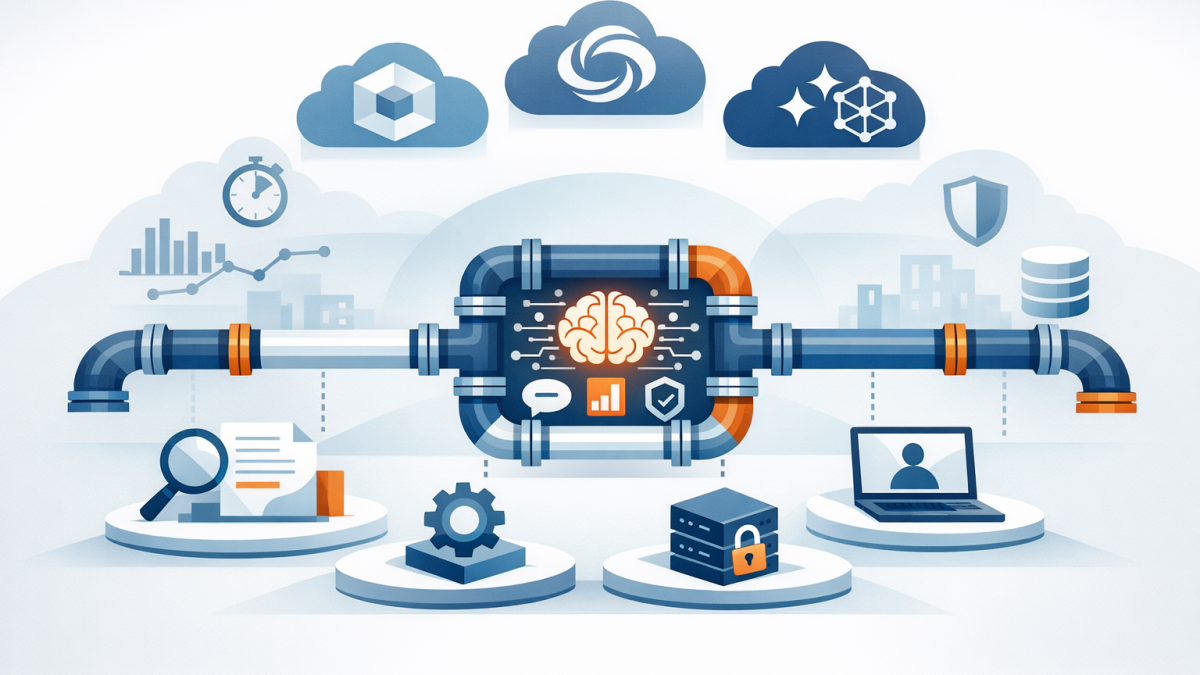
In this blog post Microsoft.Extensions.AI for Enterprise AI Applications in .NET we will look at why this new abstraction layer matters, how it works at a high level, and what enterprise leaders should consider before adopting it.
One pattern I keep running into with enterprise AI projects is that the first prototype is usually too tightly coupled to a single AI provider. It works, it demos well, and then the real questions arrive: governance, observability, cost control, vendor flexibility, security review, and long-term maintainability.
Microsoft.Extensions.AI is Microsoft’s answer to part of that problem for .NET teams. At a high level, it gives developers a common set of interfaces for working with generative AI capabilities such as chat, embeddings, streaming responses, tool calling, telemetry, and caching.
That sounds technical, but the business idea is simple. Instead of wiring your application directly to one model SDK everywhere, you create a cleaner boundary between your business logic and the AI provider sitting behind it.
The business problem it helps solve
In my experience as a Solution Architect and Enterprise Architect, the hardest part of enterprise AI is rarely the first API call. The harder part is turning a promising AI feature into something the organisation can operate safely for years.
Many teams start with direct integration to OpenAI, Azure OpenAI, Anthropic Claude, a local model, or another provider. That is perfectly reasonable for discovery work. But if that provider-specific code spreads across the application, future change becomes expensive.
I have seen this with cloud platforms, identity systems, messaging platforms, and security tooling over the last 20+ years. The pattern repeats. What begins as speed later becomes coupling.
Microsoft.Extensions.AI does not remove the need for good architecture. What it does is give .NET teams a more consistent foundation, using patterns they already understand: dependency injection, middleware, logging, telemetry, and interfaces.
What Microsoft.Extensions.AI actually is
Microsoft.Extensions.AI is not a new AI model. It is not a replacement for Azure OpenAI, OpenAI, Claude, Semantic Kernel, or model orchestration platforms.
Think of it as an abstraction layer for .NET applications. It defines common contracts such as IChatClient for chat-based model interactions and IEmbeddingGenerator<TInput, TEmbedding> for generating embeddings.
These contracts allow application code to speak to a general AI interface, while the actual implementation can sit behind that interface. That implementation might point to Azure OpenAI today, another OpenAI-compatible endpoint tomorrow, or a local model for a specific workload.
The important architectural shift is this: the application does not need to know every detail of the provider. It asks for a response, passes the right messages and options, and lets the configured client handle the provider-specific mechanics.
Why this matters for enterprise leaders
For CIOs, CTOs, and IT directors, the value is not just developer convenience. The value is optionality.
AI is moving quickly. Models improve, pricing changes, regulations mature, and internal risk appetite shifts. An abstraction layer gives an organisation more room to adapt without rewriting large parts of its application estate.
I would not describe this as full portability. No abstraction can hide every difference between models, especially when you get into reasoning quality, context windows, multimodal input, tool behaviour, latency, and content filtering.
But it can reduce unnecessary coupling. That is often enough to make future decisions easier.
The core technology in plain language
The main technology behind Microsoft.Extensions.AI is a set of standard .NET interfaces and pipeline components.
IChatClient represents a chat-capable AI service. Your application sends messages to it, such as a system instruction and a user request, and receives a response. It can also support streaming, where the response arrives progressively rather than all at once.
IEmbeddingGenerator represents a service that turns text or other input into numerical vectors. These vectors are used for semantic search, retrieval augmented generation, document comparison, and knowledge-based AI applications.
The higher-level package also supports cross-cutting capabilities such as logging, OpenTelemetry, caching, and automatic function invocation. These are not side issues. In production AI systems, they are usually the difference between a clever demo and an operational platform.
A simple example
The simplified idea looks like this. The application depends on IChatClient, not directly on every provider SDK across the codebase.
using Microsoft.Extensions.AI;

public class PolicyAssistant
{
 private readonly IChatClient _chatClient;

 public PolicyAssistant(IChatClient chatClient)
 {
 _chatClient = chatClient;
 }

 public async Task<string> SummarisePolicyAsync(string policyText)
 {
 var response = await _chatClient.GetResponseAsync([
 new ChatMessage(ChatRole.System,
 "You summarise enterprise policies in clear business language."),
 new ChatMessage(ChatRole.User,
 $"Summarise this policy for an executive audience: {policyText}")
 ]);

 return response.Text;
 }
}
This is intentionally simple. The design point is that the service class is not filled with provider-specific setup, endpoint handling, authentication details, or custom request plumbing.
Those concerns are handled at the application composition layer, where the AI client is registered. That is where architecture teams can apply standards for configuration, identity, telemetry, and environment separation.
The provider can change without rewriting the feature
In a well-structured application, provider configuration should sit close to startup and dependency injection. The business service should not care whether the underlying model is accessed through Azure OpenAI, OpenAI, or another compatible implementation.
// Illustrative registration pattern
// Exact provider setup depends on the SDK and package versions in use.

builder.Services.AddChatClient(chatClient)
 .UseLogging()
 .UseOpenTelemetry()
 .UseDistributedCache();
The exact code will vary based on the provider, version, and hosting model. The broader pattern is what matters: centralise the AI client configuration, then inject the abstraction into application services.
That gives architecture teams a cleaner way to make decisions about model routing, observability, caching, and resilience without forcing every feature team to solve those problems independently.
Where I see the strongest enterprise use cases
The first use case is internal knowledge assistants. These often combine chat, embeddings, document retrieval, and strict access controls. Microsoft.Extensions.AI can help keep the application logic separate from the underlying model choice.
The second use case is business process augmentation. Examples include summarising case notes, drafting responses, classifying requests, extracting data from documents, and assisting service desk teams. These workloads usually need repeatability, monitoring, and cost control more than experimental freedom.
The third use case is regulated AI adoption. In Australia, many organisations are already thinking about AI through the lens of privacy, cybersecurity, ASD guidance, ACSC expectations, and Essential 8 maturity. A common abstraction does not solve governance, but it can make governance easier to implement consistently.
The governance lesson
One lesson I have learned across Azure, Microsoft 365, AI, and cybersecurity projects is that governance must be designed into the platform early. Retrofitting it after teams have already shipped multiple AI features is painful.
With Microsoft.Extensions.AI, I would encourage leaders to think about a standard internal AI application pattern. That pattern should cover which models are approved, how prompts are logged, what data must be redacted, where telemetry goes, how costs are measured, and how outputs are reviewed.
This is especially important when AI features touch personal information, sensitive commercial data, or regulated business processes. Australian privacy legislation and internal security policies should influence the design from the beginning.
Do not confuse abstraction with strategy
I like what Microsoft.Extensions.AI is trying to do, but I would not treat it as an AI strategy by itself. It is a useful engineering foundation, not a substitute for operating model, risk management, data governance, or executive decision-making.
It also does not remove the need to understand model behaviour. Different models produce different results. Tool calling may behave differently. Token limits matter. Latency matters. Safety filters matter. Cost profiles matter.
The abstraction helps you avoid unnecessary code lock-in. It does not remove the need for testing, evaluation, and human judgement.
Practical steps for adoption
- Start with one production-relevant use case. Avoid building a generic AI platform before you understand the operational patterns your organisation actually needs.
- Define an internal AI client standard. Decide how teams should register clients, manage secrets, handle telemetry, and structure prompts.
- Separate business logic from provider code. Keep provider-specific details near configuration, not spread across application services.
- Instrument from day one. Track latency, failures, usage, cost indicators, and quality signals. AI without observability becomes guesswork.
- Build in security review. Consider data classification, prompt injection risks, output handling, audit logging, and access control.
How I would position it to a leadership team
If I were explaining Microsoft.Extensions.AI to an executive group, I would avoid describing it as another developer library. That undersells the point.
I would describe it as part of the enterprise AI plumbing for .NET environments. It helps create a controlled, observable, and flexible way for applications to consume AI services.
For organisations heavily invested in Microsoft technology, especially Azure and Microsoft 365, this matters. Many enterprise systems are still built in .NET, and those systems are now being asked to include AI capabilities without becoming fragile or ungovernable.
From my perspective in Melbourne, working with Australian and international organisations, this is where the conversation is shifting. The question is no longer simply “Can we add AI?” It is “Can we add AI in a way we can govern, operate, and change later?”
Final reflection
Microsoft.Extensions.AI is not the most exciting part of the AI stack, and that may be exactly why it matters. Good enterprise architecture is often about the boring layers that make future change less painful.
As a published author and architect, I have learned to pay attention to these abstraction layers. They usually signal that a technology is moving from experimentation into repeatable engineering practice.
The next phase of enterprise AI will not be won only by choosing the smartest model. It will be won by organisations that can change models, govern data, observe behaviour, and keep business logic clean while the market keeps moving.
That raises a useful question for technology leaders: are your AI prototypes creating reusable foundations, or are they quietly building the next layer of technical debt?
