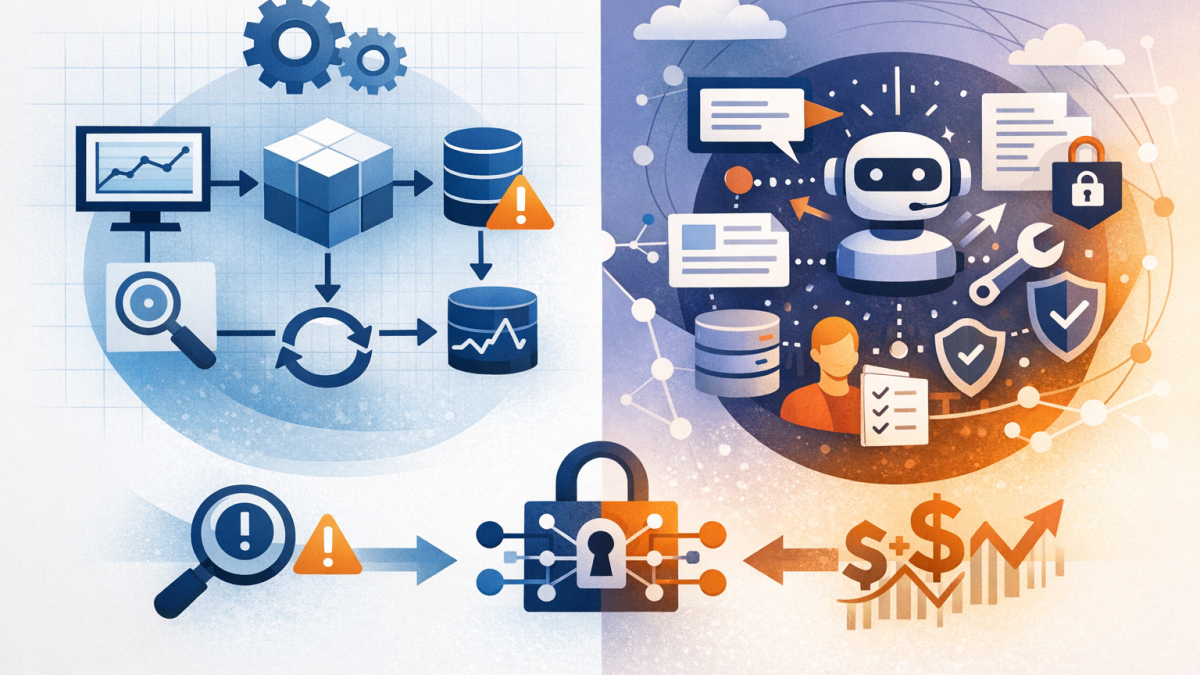
In this blog post Why GenAIOps Is Not Just MLOps for Modern Enterprise AI Teams we will look at what actually changed when AI moved from predictive models to generative systems. In my experience, many leadership teams assume they can extend their existing MLOps playbook and be done. That sounds sensible at first, but it misses the biggest shift: the thing you are operating is no longer just a model. It is a live system made up of prompts, context, tools, policies, evaluations, and human guardrails.
At a high level, MLOps was designed for models that classify, predict, score, or recommend. GenAIOps is designed for systems that generate language, reason over context, call tools, and interact with people in less predictable ways. After 20+ years working as a solution architect and enterprise architect, and more recently hands-on with Azure, Microsoft 365, OpenAI, Claude, and cybersecurity, that is the distinction I keep coming back to. It changes architecture, governance, risk, and operating models.
I do not see GenAIOps as a replacement for MLOps. I see it as an expansion. The engineering discipline is broader because the runtime is broader. As a published author, I care about language quality and clarity. As an architect, I care even more about how these systems behave under pressure, under policy, and at scale.
The high-level shift
Classic MLOps treated the model artefact as the centre of gravity. You trained it, validated it, deployed it, monitored drift, and retrained when needed. That approach still matters for many machine learning workloads.
GenAI changes the centre of gravity from model lifecycle to response lifecycle. The output is not driven only by weights in a model. It is shaped at runtime by system instructions, retrieval from enterprise content, tool permissions, safety policies, conversation history, and fallback logic. In other words, the operational problem moved closer to application architecture than many teams expected.
What changed in the technology stack
The easiest way to explain the technology is this: a generative AI system is usually an orchestration layer around a foundation model. The model is important, but it is only one component. The real business behaviour emerges from how the whole stack works together.
User request
→ policy and identity checks
→ prompt assembly
→ retrieval from approved knowledge
→ model inference
→ tool calls or MCP actions
→ safety and groundedness checks
→ optional human approval
→ response, logging, feedback, and cost tracking
That flow is why I say GenAIOps is not just MLOps with different branding. The operating unit is now a composed runtime. If one prompt changes, one connector gets broader permissions, one retrieval index goes stale, or one policy threshold is relaxed, the system can behave very differently even when the base model stays the same.
Current vendor platforms make this plain. OpenAI now treats tool use, remote MCP servers, file search, and multi-step agentic execution as first-class runtime behaviour. Anthropic is framing much of the challenge as context engineering, and features such as prompt caching are now part of cost and latency design rather than a minor optimisation. That tells me the market itself has moved from pure model management to orchestration management.
The unit of change is different
One pattern I keep running into is teams versioning the model but not versioning the behaviour. In GenAI, that is risky. A prompt rewrite, a retrieval change, a new system message, a tool schema update, or a different safety configuration can alter outcomes just as much as a model swap.
For leaders, that means release management has to mature. You need version control for prompts, evaluation sets, grounding content, tool access policies, and decision rules. If you cannot reproduce how an answer was produced last Tuesday, you do not really have operational control.
This also changes the conversation with the business. In traditional ML, the question was often, did the model predict accurately enough? In GenAI, the better question is, did the system behave appropriately for this context, this user, and this risk level? That is a broader operational question, not a narrow data science question.
Observability moved from accuracy to behaviour
MLOps gave us useful habits around testing, monitoring, and rollback. Those habits still matter, but the measures are different. Precision and recall do not tell you enough when a system is drafting policy text, summarising contracts, querying SharePoint content, or acting through enterprise tools.
What I encourage leaders to watch instead is behavioural quality. Are answers grounded in approved sources? Does the system refuse unsafe requests correctly? Does it stay inside role boundaries? How often does it call tools successfully? What is the latency by workflow? What is the token cost by user journey? How many responses require human correction?
That is why evaluation has become a first-class discipline in GenAIOps. Microsoft now provides risk and safety evaluators for generative AI workloads, including checks related to harmful content, jailbreak vulnerability, code risk, and production quality, alongside Azure AI Content Safety capabilities such as groundedness detection and Prompt Shields for adversarial inputs. In practical terms, observability is no longer just about model health. It is about trustworthiness in context.
Governance is now closer to identity and data security
This is the part many organisations underestimate. A predictive model usually consumes data and returns a score. A generative system may read internal documents, summarise email threads, draft communications, query databases, and trigger actions through APIs. The blast radius can be much larger.
That is why GenAIOps sits much closer to cybersecurity, privacy, and access governance than many earlier AI programs did. The hard questions are not only about model quality. They are about who can access what, what data can enter prompts, what tools the system can invoke, where outputs are stored, and when a human must stay in the loop.
In the Australian context, this matters even more. The OAIC has advised organisations not to enter personal information, especially sensitive information, into publicly available generative AI tools without careful consideration of privacy risks. Australian government policy was also strengthened in December 2025 to require clearer governance, accountability, and a strategic approach to AI use, while the Essential Eight remains a sensible baseline for hardening the environments these systems depend on. My view is simple: if your GenAI governance is not connected to privacy, identity, logging, and security baselines, it is incomplete.
Cost and vendor volatility are now operational issues
Another real shift is commercial, not just technical. In classic ML, models changed, but the rate of platform change was usually manageable. In GenAI, models, features, pricing, context windows, caching options, evaluation tooling, and tool protocols change fast.
That means architecture discipline matters more than ever. If your application logic is tightly coupled to one provider’s quirks, every vendor change becomes a rewrite. If your prompts, retrieval layer, evals, and policy controls are abstracted well, you can test alternatives without destabilising the whole platform.
I have seen this become a board-level conversation because cost can swing quickly. Caching, batch execution, runtime tool use, and agent loops can improve economics or blow them out depending on how thoughtfully they are governed. GenAIOps therefore needs financial telemetry as much as technical telemetry.
A practical GenAIOps operating model for leaders
When I help leadership teams think this through, I keep the operating model simple.
Treat the AI system as a product, not a model. Define an owner for the whole workflow, not just the model endpoint. Someone must own prompts, data boundaries, tool permissions, user feedback, and production quality.
Version the full interaction contract. That includes prompts, retrieval sources, evaluation sets, tool schemas, safety rules, and fallback paths. If behaviour changes, you need to know exactly what changed.
Build an eval harness before broad rollout. Do not wait for production incidents to discover hallucinations, unsafe tool calls, or weak grounding. Test for business quality and safety quality together.
Separate low-risk and high-risk paths. A drafting assistant is not the same as a system that updates records or gives regulated advice. Use different approval models, logging depth, and security controls.
Instrument cost, latency, and correction effort. A workflow that looks impressive in a demo can become expensive or unreliable at scale. Measure where humans still need to step in.
Map AI controls to existing enterprise controls. In Australia, that often means aligning GenAI governance with privacy obligations, cyber baselines, identity practices, and frameworks such as the Essential Eight rather than inventing a separate island of AI policy.
None of this is theoretical for me. Working from Melbourne with organisations across Australia and internationally, I keep seeing the same lesson: the teams succeeding with GenAI are not necessarily the ones with the most advanced model. They are the ones with the clearest operating model.
The takeaway
GenAIOps is not a fashionable rename of MLOps. It reflects a real architectural shift from managing trained models to managing dynamic, language-driven systems that interact with data, people, and tools in real time.
MLOps still gives us valuable foundations: repeatability, testing, deployment discipline, and monitoring. But GenAIOps adds a new layer of responsibility around context, behaviour, safety, permissions, and economics. That is why I believe the most important leadership question is no longer, do we have an AI model strategy? It is, do we have an operating model for systems that can reason, generate, and act inside the enterprise?
The organisations that answer that question well will not just move faster. They will move with far more control, which may be the more important advantage over the next few years.
