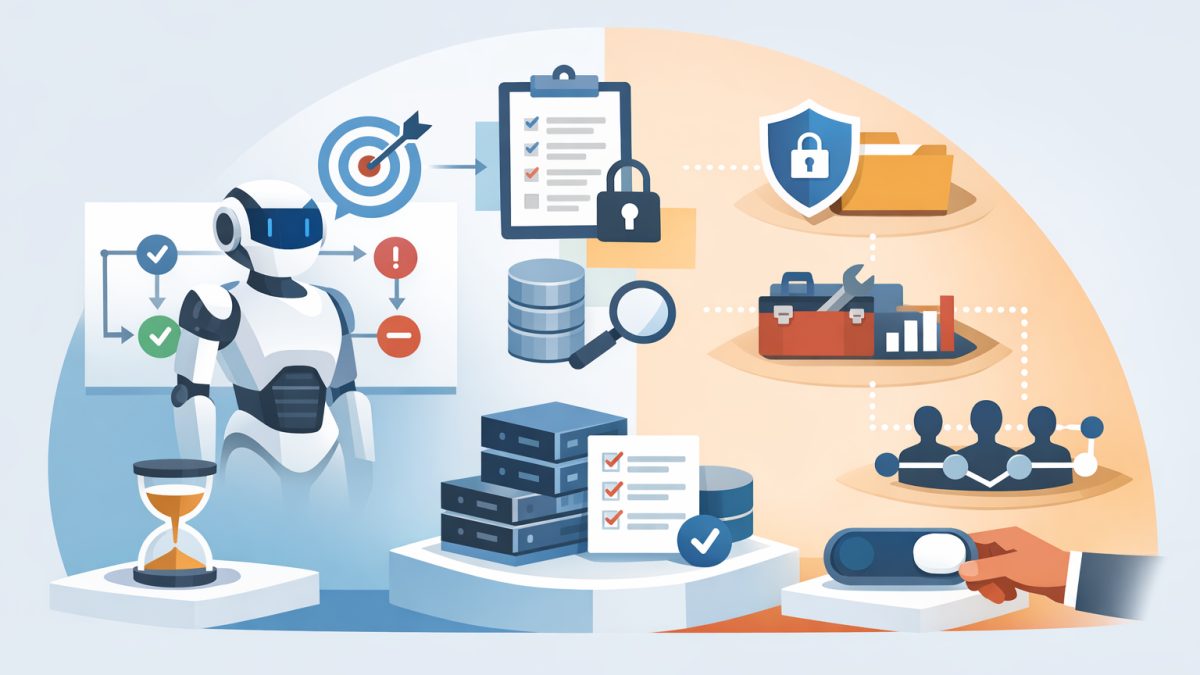
In this blog post Why Real-World Agent Architecture Needs More Than Just a Model we will look at why enterprise agents succeed or fail based less on the model itself and far more on the architecture wrapped around it.
One pattern I keep running into is this: leaders see an impressive agent demo, then assume the path to production is mostly about choosing the best model. In my experience, that is rarely the hard part. The hard part is deciding what the agent can see, what it can do, what it should remember, and how you keep it inside acceptable business and risk boundaries.
After 20+ years in enterprise IT, working as a Solution Architect and Enterprise Architect across Azure, Microsoft 365, AI, and cybersecurity, I have seen this pattern repeat with almost every new platform shift. As a published author and a hands-on architect based in Melbourne, working with organisations across Australia and internationally, the simplest explanation I trust is this: a real-world agent is not a model. It is a controlled decision loop built around a model.
Start with the high-level picture
At a high level, an agent is software that receives a goal, reasons about the next step, uses tools or data when needed, and then decides whether to continue, escalate, or stop. The model is the reasoning engine, but the wider system usually needs instructions, retrieval, actions, and memory to work reliably in an enterprise setting.
That distinction matters because too many teams still treat agents as slightly more advanced chatbots. They are not. Once an agent can call systems, retrieve internal information, trigger workflows, or operate over multiple turns, you are designing a business system with autonomy, not just a user interface with better text generation.
The model is only the reasoning engine
Modern platforms make this clearer than ever. They now ship agent runtimes with built-in tools, multi-turn state, tracing, and orchestration because the industry has learned that a model alone is not enough for real work. In other words, the platform direction itself is telling us something important: agent architecture has become a systems problem, not just a prompt problem.
In practical terms, I think about the model as the component that chooses and explains. It does not hold the source of truth, enforce policy, manage identity, or safely execute every action on its own. If you expect it to do all of that inside one giant prompt, reliability drops very quickly.
Context is architecture now
One of the most important recent shifts in agent design is the move from prompt engineering to context engineering. Context is finite. Every instruction, tool definition, retrieved document, previous message, and intermediate result competes for space and attention, which means the quality of the context window is an architectural concern, not a writing exercise.
In my experience, many poor agent outcomes come from bad context decisions rather than bad models. Teams give the agent too much irrelevant information, too little authoritative information, or no clear priority order. Then they blame the model for behaving inconsistently when the real issue is that the system gave it a confusing operating environment.
This is why retrieval design matters so much. If your knowledge sources are fragmented, stale, or weakly governed, the agent will sound confident while standing on shaky ground. Authoritative content, permission-aware retrieval, and clean data boundaries do more for enterprise trust than swapping between one frontier model and another.
Tools create value and risk at the same time
The real power of an agent appears when it can do something, not just say something. That usually means tools: APIs, workflow calls, search, file access, database queries, or actions inside platforms such as Microsoft 365 and Azure. But the moment you add tools, you also add blast radius.
One lesson I keep sharing with technology leaders is that tool access should be designed like privileged access, not like a convenience feature. The common failure mode is giving the agent broad permissions because it makes the demo smoother. Later, the same design becomes a security, audit, or data leakage problem.
That is also why open connection standards are getting attention. MCP is designed as an open standard for connecting AI applications to external tools and data sources, and its architecture separates hosts, clients, and servers so security boundaries can be maintained more cleanly. I see real value in that direction, especially for organisations that want interoperability without hardwiring every agent to one vendor-specific integration approach.
Memory and state are where trust is won or lost
A lot of agent conversations focus on intelligence, but operational trust often comes down to memory and state. Can the agent keep track of what it already did? Can it resume long-running work? Can it avoid repeating the same failed action? Can you inspect the trail afterward? These are architecture questions, not model benchmark questions.
I have seen agents appear smart in a five-minute demo and then fall apart in production because they had no durable state strategy. They forgot assumptions, re-ran tasks, lost intermediate outputs, or mixed one user session into another. For leaders, this usually shows up as inconsistency, cost drift, and low confidence from the business.
A useful mental model is to separate three things. Working memory for the current task. Durable memory for approved state that should survive across sessions. And audit memory for what happened, why it happened, and which tools or data sources were involved.
What the technology often looks like in practice
When I review an enterprise agent design, I usually want to see a loop more like this rather than a single prompt talking directly to production systems. This is the sort of pattern that tends to scale better and fail more safely.
User request
 -> policy and identity check
 -> retrieve trusted context
 -> model plans next step
 -> approved tool call
 -> validate result
 -> human approval for high-impact actions
 -> execute
 -> trace, log, and update state
Notice what is missing from that diagram: blind autonomy. In most enterprise environments, the best architecture is not the one that gives the agent maximum freedom. It is the one that gives the agent enough freedom to be useful, while making approvals, controls, and recovery paths explicit.
Governance cannot be added later
This point matters even more in Australia. If an agent handles personal information, your design choices quickly intersect with the Privacy Act 1988 and the Australian Privacy Principles. Those principles are not abstract legal footnotes. They affect how you collect, expose, retain, and secure information inside the agent workflow.
The same applies to cybersecurity baselines. The ACSC recommends the Essential Eight as foundational mitigation strategies, and the maturity model gives organisations a way to assess whether controls are just present on paper or actually operating as intended. If your agent can access endpoints, identities, documents, or admin workflows, it should be assessed in the same security conversation, not treated as a special exception because it is AI.
I also think agent governance needs to be mapped into existing enterprise risk practices, not run as a side project. The most useful guidance I see today reinforces that organisations should define data governance, observability, security controls, and responsible AI policies as part of the operating model. That fits what I have seen in architecture boards for years: what gets embedded survives, and what sits beside the process usually gets bypassed.
Start simpler than you think
Another lesson worth repeating is that not every problem needs an agent. Current architecture guidance is very clear that complexity sits on a spectrum, and if a direct model call or a simple workflow solves the problem, you should start there. I strongly agree. Some of the best enterprise outcomes come from disciplined restraint, not architectural ambition.
My default sequence is simple. First, prove the business value with the lowest possible level of autonomy. Second, add retrieval only when authoritative grounding is required. Third, add tools only where action genuinely improves the outcome. Fourth, introduce multi-agent orchestration only when a single agent clearly cannot handle the task, security boundary, or domain complexity.
The question leaders should really ask
When a team tells me they want to build an agent, I no longer start by asking which model they want. I ask what decisions the agent will make, what systems it will touch, what evidence it will use, what permissions it will hold, and how we will know when it is wrong. Those questions usually reveal the real architecture faster than any vendor demo ever will.
The next phase of enterprise AI will not be won by the organisations with the most agents. It will be won by the organisations whose agents are understandable, governable, and trusted enough to operate in the real world. The model still matters, of course. But in my experience, the architecture around it matters more.
- Copilot Memory is Now Default and I’d Disable It in 3 Cases
- From Demo to Production with Microsoft Agent Framework for Architects
- MCP A2A OpenTelemetry and OAuth Every Architect Must Track in 2026
- Why Agent Legibility Will Matter More Than Better Prompting for CIOs
- About
