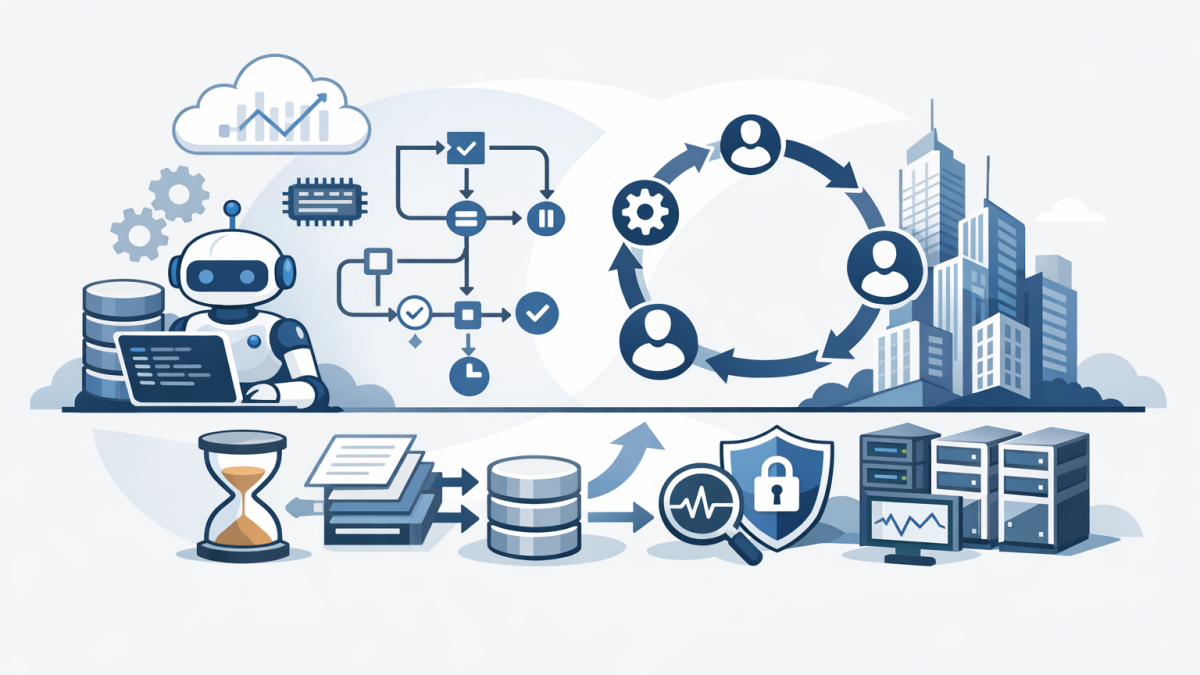
In this blog post From Demo to Production with Microsoft Agent Framework for Architects we will look at what really changes when an AI idea leaves the demo environment and has to survive inside a real enterprise. From where I sit, that is the most important lens for Microsoft Agent Framework.
The headline is not that Microsoft has released yet another agent SDK. The real story is that the framework has matured into a more serious platform direction, with a Release Candidate milestone reached for both .NET and Python in February 2026, which is exactly the kind of signal architects watch before treating something as more than a lab experiment.
At a high level, Microsoft Agent Framework brings together ideas that were previously spread across Semantic Kernel, AutoGen, tool calling, memory, hosting, and orchestration. It gives teams a common way to build agents, connect them to tools and external systems, manage state across conversations, and wrap the whole thing in workflows, middleware, and observability. In plain English, it tries to turn agentic AI from clever prompt engineering into an actual application architecture.
Why this matters more than most leaders first assume
One pattern I keep running into is this. A team can build an impressive assistant in a week, and leadership walks away thinking the hard part is done. In reality, the hard part usually starts the moment someone asks four simple questions.
- How does it remember the right things and forget the wrong ones?
- What can it call, change, approve, or execute?
- How do we know why it made a decision?
- What happens when it fails halfway through a business process?
Demos hide those questions. Production exposes them. That is why I think Microsoft Agent Framework matters. It does not magically solve architecture, but it does move a lot of production-grade concerns into the framework itself, where they can be handled more consistently.
The technology behind Microsoft Agent Framework in plain English
The easiest way to understand the framework is to think of it as a runtime and set of building blocks for AI agents, rather than as a single product feature. Under the hood, Microsoft defines a common agent abstraction, supports multiple model providers, and adds the plumbing needed for state, tools, orchestration, hosting, and telemetry.
- Agents are the decision-making units. They use a language model, follow instructions, and can call tools when needed. Microsoft’s common AIAgent abstraction matters because it gives architects a more consistent way to compose different agent types.
- Sessions and memory handle conversational state. AgentSession keeps context between runs, and context providers let you inject or extract business context in a controlled way rather than hoping the model remembers everything.
- Middleware acts like a policy and control layer. It can intercept agent runs and function calls for logging, validation, security checks, and error handling. That is a major shift from ad hoc prompt wrappers.
- Workflows provide graph-based orchestration. They support explicit routing, checkpointing, human-in-the-loop steps, and multi-agent coordination, which is far closer to how enterprise processes actually behave.
- Tools and protocols connect agents to the outside world. That includes function tools, MCP-based tools, and agent-to-agent communication through A2A, which matters if you want interoperability instead of one giant monolith.
- Observability and hosting are built in from the start. The framework integrates with OpenTelemetry and provides hosting options for ASP.NET Core, durable functions, A2A exposure, and OpenAI-compatible endpoints.
If I compress all of that into one sentence, the framework gives architects a way to separate reasoning, orchestration, control, and execution instead of bundling everything into one brittle agent prompt.
What really changes for architects
You design a runtime, not just a prompt
That is the biggest shift. In early AI projects, teams obsess over prompt wording and model choice. In production, the design questions are different. Where is state stored, who approves tool use, how is telemetry captured, what can be resumed after failure, and which tasks should remain deterministic?
Microsoft Agent Framework pushes those questions into the foreground. In my view, that is healthy. It forces a conversation about operating model, not just model performance.
You must stop treating every business problem as an agent problem
One of the most useful ideas in the framework is the explicit distinction between an agent and a workflow. Microsoft’s own guidance is refreshingly clear here. Use an agent when the task is open-ended, conversational, or needs dynamic planning. Use a workflow when the process has defined steps, control points, and business rules. If a normal function can do the job, use the function.
I wish more AI programmes started there. A lot of failed agent designs are really workflow problems wearing an AI costume. For CIOs and CTOs, that distinction matters because it affects risk, auditability, and operating cost.
State becomes a first-class architecture concern
In a demo, memory often means keeping the chat window open. In an enterprise system, memory means something else entirely. It means knowing what context is durable, what must be redacted, what can be restored after a restart, and what should never be persisted in the first place.
Agent sessions and context providers are important because they make this explicit. That helps architects define how customer context, case history, document summaries, and policy instructions are injected into a run instead of leaving everything to an oversized prompt.
Governance moves closer to the execution path
This is where I think the framework becomes genuinely useful for larger organisations. Middleware, tool approval patterns, checkpointing, and observability bring control closer to the place where the agent actually acts. That is much better than trying to bolt governance on afterward with a dashboard and a policy PDF.
For Australian organisations, this point lands quickly. If you operate in environments shaped by the Essential Eight, privacy obligations, board-level cyber oversight, or strict data handling expectations, you cannot treat agents as harmless copilots. You need clear boundaries around tool access, data movement, approval paths, and logging. Microsoft’s own documentation explicitly warns that third-party servers or agents can push data outside your organisation’s Azure compliance and geographic boundaries. That is not a technical footnote. That is an architecture decision.
Interoperability becomes a strategic design choice
Another meaningful change is the direction toward open protocols and multi-model support. The framework supports a range of model back ends and can integrate with MCP tools and A2A communication. For leaders, that matters because it reduces the chance that your first agent platform becomes your next lock-in problem.
That said, interoperability is not the same as simplicity. It gives you options, but it also demands stronger architecture standards. Naming, identity, data contracts, tool permissions, and telemetry conventions all become more important when agents can talk to other agents and external tools.
A practical production pattern I would start with
After 20 plus years in enterprise IT, and a lot of hands-on work across Azure, Microsoft 365, AI, and cybersecurity, I have become cautious about elegant diagrams that collapse under operational pressure. If I were shaping a first serious implementation today, I would start with a deliberately boring pattern.
- A small, focused agent for one bounded task such as triaging service requests or summarising contract changes.
- A workflow around it for the deterministic steps, approvals, and integrations.
- Middleware for policy checks, PII controls, and tool validation.
- Session and context design that separates transient chat history from durable business state.
- OpenTelemetry from day one so latency, failures, tool calls, and cost are visible early.
Conceptually, it looks something like this.
// Conceptual example, simplified for architecture discussion
agent = SupportRiskAgent(
 model='Azure OpenAI',
 tools=[searchKnowledgeBase, createTicket],
 context=[customerProfile, policySummary],
 middleware=[piiGuard, approvalGate, auditLogger]
)

workflow = IntakeWorkflow()
 .step(classifyRequest)
 .step(runAgent)
 .step(managerApprovalIfHighRisk)
 .step(updateSystemOfRecord)
 .withCheckpointing()
 .withTelemetry()
Notice what is happening there. The agent is not the whole system. It is one intelligent component inside a governed process. In my experience, that is the mental model that separates sustainable delivery from expensive rework.
What decision-makers should watch over the next 12 months
Because the framework is moving quickly, I would watch three things. First, how stable the APIs and hosting patterns remain as Microsoft pushes toward general availability. Second, how well enterprises operationalise approvals, observability, and data boundary controls in real environments. Third, whether teams keep the discipline to use workflows for deterministic work and agents only where judgement and flexible reasoning truly add value.
As a published author, and as someone based in Melbourne working with organisations across Australia and beyond, I find the most valuable technologies are rarely the ones with the loudest launch story. They are the ones that make good architecture easier to repeat. That is why Microsoft Agent Framework has my attention.
My view is simple. Microsoft Agent Framework does not change the laws of enterprise architecture. It changes how much of the hard, repetitive plumbing around state, orchestration, hosting, and control is now available as a coherent foundation. The organisations that benefit most will not be the ones building the flashiest demos. They will be the ones disciplined enough to turn agents into well-governed systems. The real question is whether we are ready to architect agents with the same seriousness we apply to every other critical platform.
- OpenAI Agents SDK vs LangGraph in 2026 What CIOs should standardise on
- Enterprise AI Agents Need Standards Before They Need Scale in 2026
- Why Agent Legibility Will Matter More Than Better Prompting for CIOs
- MCP A2A OpenTelemetry and OAuth Every Architect Must Track in 2026
- About
