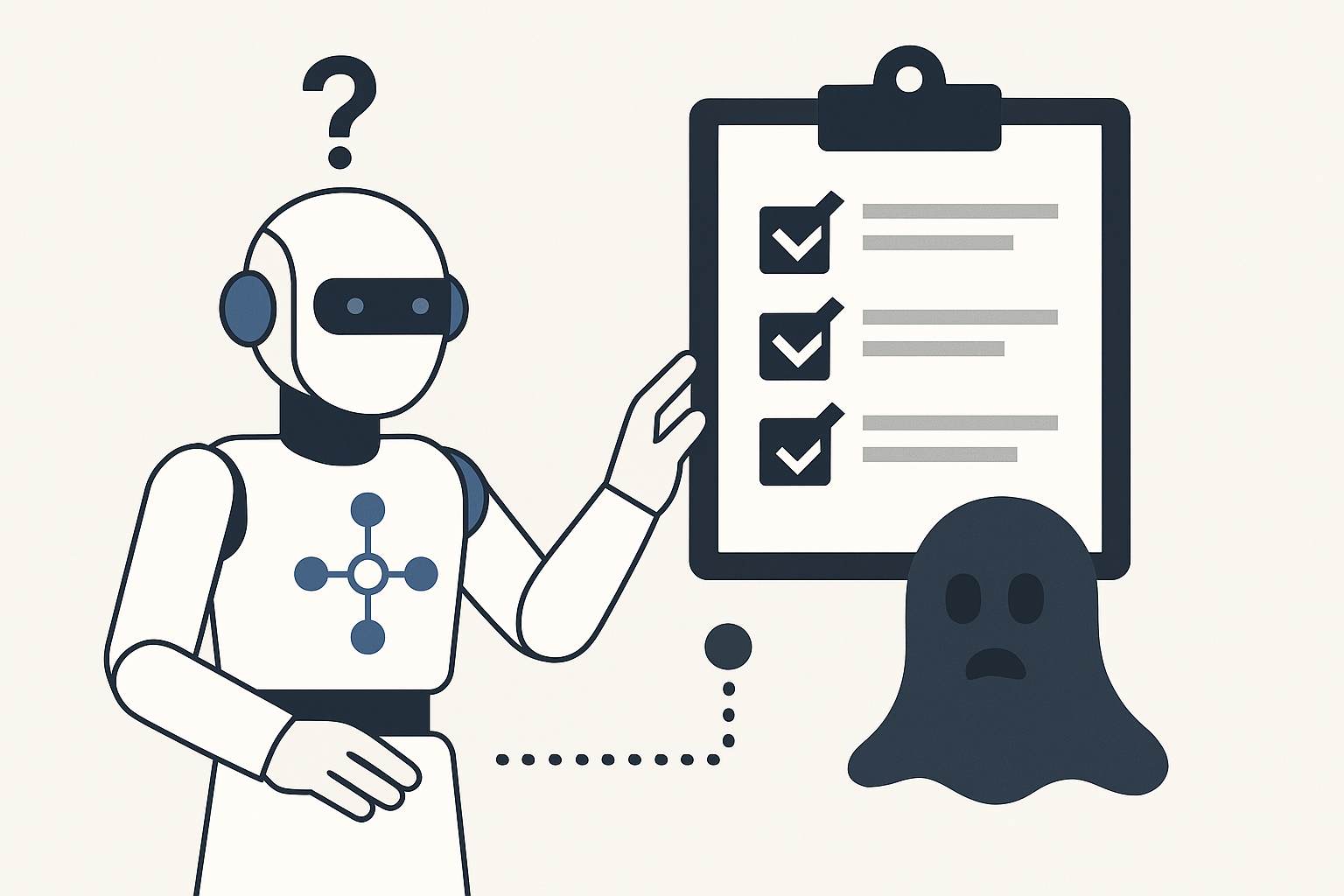
In this blog post The Hidden Risk in Enterprise Agentic AI and Silent Failures we will look at why the most dangerous agent failures are often the ones nobody notices. In my experience, enterprise AI rarely breaks with a dramatic error. It usually returns a polished answer, a completed task, or a reassuring status update that hides the fact that something important never happened.
At a high level, agentic AI is simply a large language model connected to tools, data, and workflow logic so it can do multi-step work on a user’s behalf. A modern agent can search, retrieve documents, call an API, write back to a system, and decide what to do next. That is exactly why silent failure matters. Once an agent can act, a plausible-looking mistake becomes an operational risk, not just a bad paragraph.
After more than 20 years working across enterprise architecture, Azure, Microsoft 365, AI, and cybersecurity, I have found that senior leaders usually worry about the obvious failures first. Hallucinations. Data leakage. Prompt injection. Those are real risks. But the failures that create the most expensive clean-up are often quieter. The agent appears to have done the work, the logs look normal at a glance, and the business only discovers the issue days or weeks later.
What silent failure actually means
NIST describes a common generative AI risk as confabulation, where systems confidently present false content. In enterprise agentic AI, I see a related but broader problem. The answer can sound reasonable while the process underneath it was incomplete, stale, misrouted, or unauthorised. In other words, the text looks successful even when the workflow was not.
A few examples come up again and again in real projects.
- The agent queried one source system, but silently lost access to a second one and never told anyone.
- A tool call timed out, so the agent answered from partial context.
- A policy check was supposed to run before an action, but the orchestration skipped it on retry.
- The agent completed nine out of ten steps and still reported success.
- A summary was generated from stale documents because the retrieval layer indexed the wrong version.
None of these failures look dramatic in a demo. In production, they can distort decisions, delay approvals, and create audit headaches.
How the technology creates the risk
To understand silent failure, it helps to understand the basic stack behind agentic AI. Most enterprise agents now combine five moving parts, and every one of them can fail differently. Major platforms from Microsoft, OpenAI, and Anthropic now expose these layers directly through tools, orchestration, tracing, evaluation, and schema-controlled tool use. That tells me this is no longer an experimental pattern. It is the operating model.
- The model interprets intent and decides what to do next.
- The tool layer gives the model access to search, files, APIs, and business systems.
- The orchestration layer manages retries, sequencing, state, and handoffs.
- The memory and context layer determines what the agent knows at each step.
- The observability layer records what actually happened so teams can inspect and improve it.
When leaders hear that an agent is only using a language model, they often underestimate the operational complexity. In reality, an enterprise agent behaves more like a distributed workflow with probabilistic decision-making inside it. That combination is powerful, but it is also why silent failures are so easy to miss.
Why silent failures are more dangerous than visible ones
A visible failure creates friction. A silent failure creates false confidence. From a governance perspective, false confidence is worse because it invites the organisation to keep moving based on bad assumptions.
I have seen this most clearly in document-heavy and decision-heavy environments. Procurement. Service operations. Internal support. Compliance reviews. Executive reporting. In those settings, a wrong answer is bad, but a workflow that looks complete when it is not can contaminate downstream work very quickly.
This is also why I do not think accuracy alone is the right success metric for enterprise agents. A response can be linguistically accurate enough and still be operationally wrong. Leaders need evidence that the right controls ran, the right systems were queried, and the right thresholds were met.
The pattern I now recommend
When I design or review agentic solutions, I push teams to treat silent failure as a first-class architecture problem, not a model tuning problem. That changes the controls you put in place.
1. Require evidence, not just answers
If an agent says a task is complete, it should be able to show why. Which systems did it query. Which tools ran. Which approval rule passed. Which document version was used. If the answer matters to the business, the evidence trail matters just as much.
2. Instrument the workflow, not only the chat
One of the most useful shifts in the last year has been the move toward tracing and evaluation as core platform capabilities. That is important because the final response is only the surface. The real story sits in the chain of tool calls, retries, state changes, and guardrail decisions underneath it.
3. Make tool contracts strict
A surprising number of silent failures start with bad parameters. A date field in the wrong format. A missing customer ID. A location value that looks plausible but is not valid for the target system. Schema validation and strict tool definitions reduce a lot of this avoidable noise before it becomes a business issue.
4. Separate low-impact tasks from high-impact actions
I am comfortable with more autonomy when the agent is drafting, summarising, or routing. I am far less comfortable when it is approving, deleting, changing entitlements, or updating records that affect finance, privacy, or regulatory obligations. The control model should reflect that difference.
5. Treat retries and fallbacks as risk events
Many teams still treat retries as harmless plumbing. I do not. If an agent had to retry three times, switch tools, or answer from partial context, that is not just a technical detail. It is operational signal. In some workflows, it should lower confidence, trigger review, or stop the transaction entirely.
A simple implementation pattern
You do not need a huge platform program to improve this. Even a lightweight validation layer makes a difference. Here is the kind of pattern I like to see early.
result = run_agent(task)

checks = {
 'all_required_steps_ran': validate_steps,
 'all_tool_calls_succeeded': validate_tools,
 'evidence_attached': validate_evidence,
 'policy_checks_passed': validate_policy,
 'human_review_required': needs_review(result)
}

if not all(checks.values()):
 mark_status('needs_review')
else:
 mark_status('ready')
This is not glamorous engineering. It is discipline. In my experience, that discipline matters more than adding another clever prompt.
The Australian context matters
For Australian organisations, silent failure is not just a quality problem. It can become a governance, privacy, and cyber resilience problem very quickly. ACSC guidance on engaging with AI points organisations back to existing security practice, including the Essential Eight, and highlights issues such as data residency, sovereignty, and understanding how AI systems are secured. The latest Essential Eight maturity model remains the November 2023 version, and OAIC guidance explicitly tells organisations using cloud-based generative AI to consider where servers are located and whether personal information could be disclosed outside Australia.
That is one reason I think Australian leaders should resist the temptation to frame agentic AI as only an innovation topic. It is also an architecture topic, a cyber topic, and a data governance topic. If an agent silently skips a control, uses the wrong source, or moves sensitive information across boundaries, the impact is not theoretical.
What boards and executives should ask
- How do we know when the agent completed only part of the workflow?
- What evidence do we retain for each significant agent decision?
- Which actions are allowed without human review, and why?
- How do we detect stale retrieval, missing tools, or degraded permissions?
- What happens when the agent is uncertain but still sounds confident?
If your team cannot answer those questions clearly, the issue is probably not the model. It is the operating design around the model.
Final thought
As someone based in Melbourne and working with organisations across Australia and internationally, I think we are entering a more serious phase of enterprise AI adoption. The conversation is shifting from what agents can do to what they can be trusted to do repeatedly, safely, and transparently. That is the right shift.
In the next wave of enterprise AI, the winners will not be the organisations with the most impressive demos. They will be the ones that design for the quiet moments when the agent almost succeeds, reports success anyway, and gives people just enough confidence to miss the warning signs. That is where real architecture still matters.
- How to Evaluate Agent Platforms in 2026 with Identity First in Mind
- Enterprise AI Agents Need Standards Before They Need Scale in 2026
- MCP A2A OpenTelemetry and OAuth Every Architect Must Track in 2026
- OpenAI Agents SDK vs LangGraph in 2026 What CIOs should standardise on
- Anthropic’s DoD stance just changed what “safe” enterprise AI means
