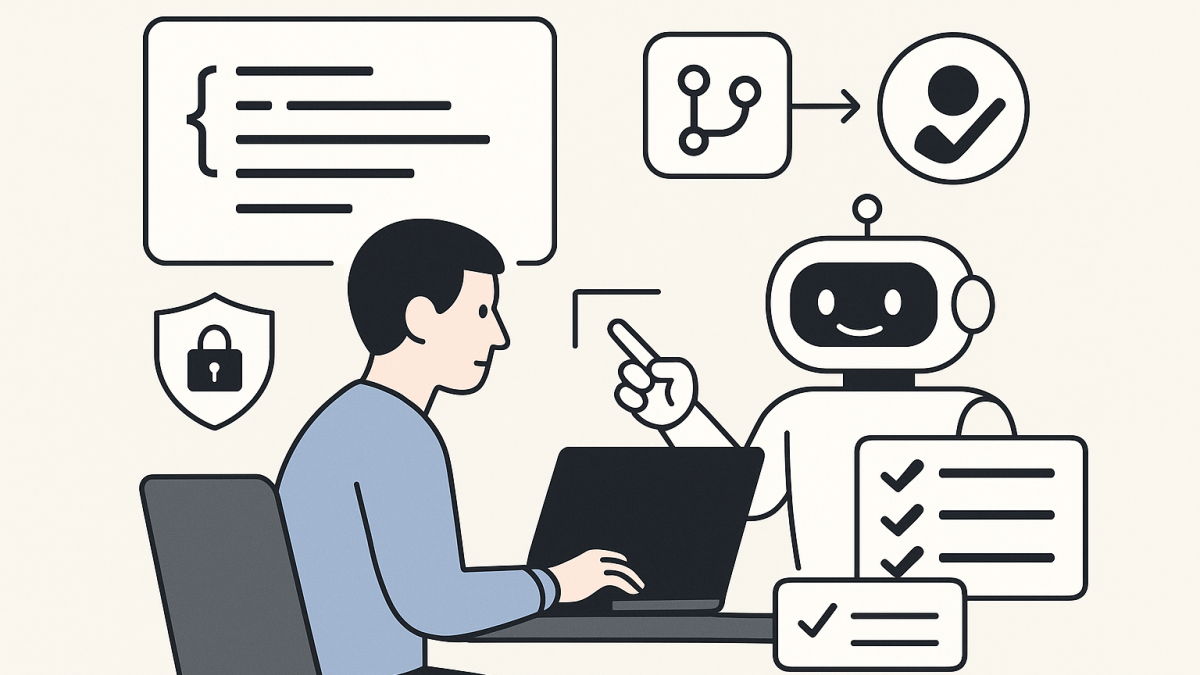
In this blog post CIO Checklist for GitHub Agents Copilot Codex and Claude Code Without Blowing Up Risk we will walk through a practical, risk-first way to introduce AI coding agents into enterprise delivery workflows.
CIO Checklist for GitHub Agents Copilot Codex and Claude Code Without Blowing Up Risk is the conversation I keep having with technology leaders right now. Everyone sees the productivity upside. The real question is whether your controls, assurance, and operating model are ready for software changes that can be initiated and progressed by an autonomous agent.
At a high level, “GitHub agents” and tools like Copilot coding agent, OpenAI Codex, and Claude Code are not just autocomplete. They’re closer to a junior engineer who can read a repository, make edits across multiple files, run tests, and propose a pull request while you’re in another meeting.
That shift matters because it changes the shape of risk. The biggest failures I’ve seen aren’t “the model wrote bad code.” They’re “we introduced a new actor into the SDLC, but we didn’t update identity, policy, audit, and approvals to match.”
High-level concept what’s actually happening under the hood
These tools combine three building blocks.
- A capable model that can reason over text and code, produce patches, and follow instructions.
- Tool access so the model can take actions, such as reading files, editing files, running commands, creating branches, opening pull requests, and responding to review comments.
- An execution environment such as a sandbox or a CI runner where the agent can run tests and validate changes without touching production.
In practice, a coding agent is a workflow that looks like this.
- The agent is given a task and a scope, usually via an issue or a prompt.
- It checks out the repository, examines relevant files, and proposes a plan.
- It makes changes, runs linters and tests, and iterates until it passes.
- It opens a pull request and asks for a human review.
- It responds to feedback, potentially across multiple rounds.
That is why I treat agents as “automated contributors” that must be governed like any other privileged actor in your engineering system.
My CIO checklist the minimum controls before you scale
I’m writing this from the perspective of an Enterprise Architect who has spent 20+ years watching good organisations ship fast and still stay safe. These are the controls that reduce the chance you wake up to an avoidable incident, an audit finding, or a surprise legal conversation.
1) Define where agents are allowed to work and where they are not
Start by classifying repositories into tiers. Not everything deserves “agent access” on day one.
- Tier 1 marketing sites, internal tools, non-production scripts.
- Tier 2 business applications with customer impact but strong test coverage and mature pipelines.
- Tier 3 identity, payments, regulated systems, cryptography, safety-critical workloads.
My rule of thumb is simple. Tier 1 is where you learn. Tier 2 is where you scale. Tier 3 is where you move slowly, with explicit sign-off and stronger guardrails.
2) Treat the agent as an identity with least privilege
If an agent can create branches and open PRs, it has power. Give it a dedicated identity and permissions that match the job.
- Separate agent identities from human identities.
- Restrict write access to protected branches.
- Limit which repos the agent can see.
- Prefer short-lived tokens over long-lived secrets.
This is the same discipline we apply to service principals in Azure. The difference is the agent will generate new code paths you didn’t explicitly anticipate, so the blast radius needs to be small.
3) Make human approval non-negotiable
In every organisation I’ve advised, the safe default is “agents can propose, humans can merge.”
- Require PR reviews by CODEOWNERS for sensitive folders.
- Require status checks to pass before merge.
- Block self-approval patterns, including “agent approves agent.”
If you want to go further, add a rule that high-risk changes (auth, encryption, network egress, secrets handling) require a security review. It’s not about mistrusting the tool. It’s about designing for reality.
4) Make test coverage a gate not a nice-to-have
Agents can generate code quickly. If your test suite is weak, you’ll ship defects quickly too.
- Set minimum unit test coverage thresholds for agent-authored code paths.
- Enforce linting, SAST, and dependency scanning in CI.
- Require reproducible builds.
One pattern I keep running into is leaders trying to introduce agents before they have a disciplined pipeline. In my experience, do the pipeline first. The agent will amplify whatever maturity level you already have.
5) Decide your data boundaries up front
AI tools create new paths for data to leave a boundary, even when nobody intends it.
- Define what code is allowed to be processed by external services.
- Define how secrets are detected and blocked (pre-commit and in CI).
- Define how prompts and outputs are logged, retained, and reviewed.
In Australia, I also recommend aligning this with your privacy posture and internal policies, especially if you operate under the Privacy Act and need to be explicit about where data is processed and stored.
6) Map controls to Essential Eight so security can say yes safely
When you anchor agent adoption to a recognised framework, you reduce friction. For many Australian organisations, the Essential Eight is the common language.
- Application control ensure agent tooling is approved and managed.
- Patch applications keep IDEs, extensions, runners, and agent components updated.
- Restrict admin privileges avoid running agent tooling with elevated permissions.
- Multi-factor authentication enforce MFA for all human accounts that can approve merges.
- Backups ensure repos and build artifacts are recoverable and immutable where needed.
I’m not saying “make it bureaucratic.” I’m saying “make it governable.” Leaders can’t defend what they can’t explain.
7) Set policy for licensing and IP risk
Agents can introduce licensing issues if you’re not watching. This is less about a single catastrophic event and more about slow drift that becomes expensive later.
- Run automated license scanning on dependencies.
- Enforce contribution rules and review for unusual code blocks.
- Define what “acceptable reuse” looks like in your engineering standard.
As a published author, I’m sensitive to provenance. It’s worth having a lightweight policy that says what you do when code origin is unclear, especially in regulated environments.
8) Monitor agent behaviour like a new class of user
Don’t wait for the first incident to realise you don’t have visibility.
- Track where agent PRs occur and how often they are reverted.
- Track which repos receive the most agent activity.
- Track security findings introduced by agent PRs versus human PRs.
If your telemetry can’t answer “what did the agent change last week and why,” you’re not in control yet.
A real-world scenario I’ve seen and how we de-risked it
A large organisation I worked with had a very common setup. Hundreds of repos, mixed maturity, and a constant backlog of tech debt. Developers were already using AI assistants in the IDE, and leadership wanted to move to autonomous PR creation to speed up dependency upgrades and test improvements.
The first attempt went sideways. Not because the agent was “evil,” but because it was given too much access too early. It touched multiple repos, produced large PRs, and created review fatigue. Some changes landed with shallow scrutiny because the team just wanted the queue to go away.
We reset the program with three decisions.
- We limited the agent to a small set of Tier 1 repositories for 60 days.
- We enforced “small PRs only” and required tests to be added when changing behaviour.
- We added a routing rule. If the agent touched auth, secrets, or network egress, the PR was automatically tagged for security review.
Within a quarter, the organisation got real value. Dependency upgrades happened faster. Documentation improved. Developers trusted the workflow because it was predictable. Security stopped feeling like they were being asked to approve magic.
Practical steps to implement in GitHub without getting too fancy
If you want a simple starting point, this is the sequence I recommend.
- Pick two pilot teams that already have decent CI hygiene and strong reviewers.
- Choose three use cases dependency upgrades, test coverage uplift, and documentation improvements.
- Define agent permissions PR creation yes, merge no, protected branches enforced.
- Make PR templates stricter include “what changed,” “how tested,” and “risk notes.”
- Measure outcomes lead time, change failure rate, and reviewer time.
Here’s an example PR checklist snippet I’ve used to reduce risk while keeping delivery moving.
- [ ] PR is < 300 lines changed unless explicitly approved
- [ ] Tests added or updated for behavioural changes
- [ ] CI passed (unit, lint, SAST, dependency scan)
- [ ] No secrets in diff (validated by scanner)
- [ ] Auth/secrets/network changes tagged for security review
- [ ] Rollback plan noted if change impacts runtime behaviour
It’s not glamorous. It works.
Where Copilot Codex and Claude Code fit in practice
I’m deliberately tool-agnostic, because organisations rarely standardise on one assistant. In Melbourne and across Australia, I see mixed environments all the time.
What matters is that you decide which mode you’re enabling.
- Inline assistance helpful, lower risk, still needs policy and training.
- Agent sessions higher leverage, higher governance requirements.
- Asynchronous PR agents biggest workflow change, needs strong approvals and telemetry.
In my experience, the risk conversation becomes much simpler when you phrase it like this. “We’re not adopting an AI feature. We’re introducing a new automated contributor into our SDLC.”
Closing reflection
AI coding agents are going to feel normal sooner than most leaders expect. The winners won’t be the organisations that ban them or blindly embrace them. They’ll be the ones that build a safe runway, prove value in constrained pilots, and then scale with controls that are proportional to the risk.
If you had to explain to your board or an auditor, in plain language, exactly how an agent can change production-bound code in your environment, could you do it today?
