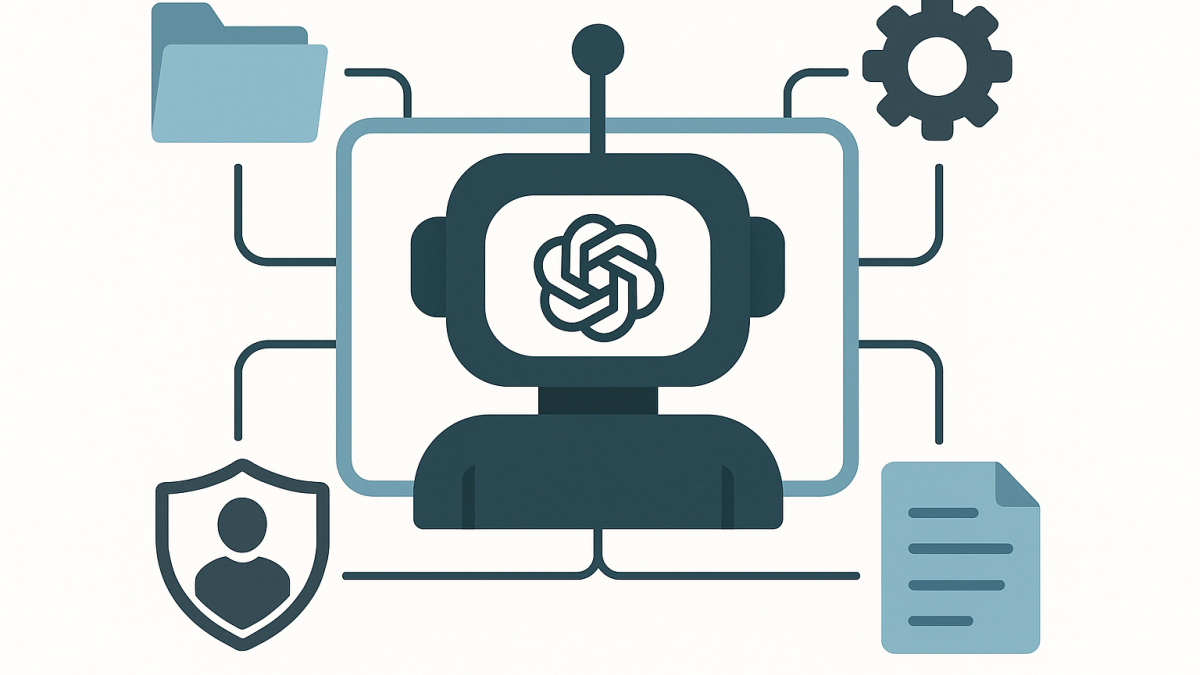
In this blog post OpenAI Frontier Explained What This New Enterprise Platform Actually Does we will unpack what Frontier is, what it isn’t, and how I’d evaluate it as an architect responsible for real-world delivery.
The first time I read about OpenAI Frontier Explained What This New Enterprise Platform Actually Does, my immediate reaction was simple: this isn’t “another chatbot.” It’s an attempt to turn AI from scattered experiments into something you can run like a proper enterprise platform.
In my experience, that’s the hard part of AI. Model quality matters, but getting AI to do useful work consistently, safely, and repeatably across systems is where most organisations stall.
High-level explanation first
At a high level, Frontier is an enterprise platform designed to build, deploy, and manage AI agents that can take actions across your business systems.
Think of it as the layer that sits between “powerful AI models” and “messy enterprise reality.” It tries to provide shared business context, controlled execution, evaluation, and governance so agents can operate in production without turning into a security or compliance incident.
The real enterprise problem Frontier is trying to solve
One pattern I keep running into across Australia (and internationally) is what I call pilot gravity. A team proves value with a clever demo, then everything falls apart when it touches identity, data access, audit, change control, and risk.
Frontier is essentially saying: “Stop building one-off agents. Standardise how you onboard them, constrain them, observe them, and improve them.” That’s a familiar enterprise move, and honestly, it’s overdue in the agent space.
What Frontier actually does in practice
Based on what’s been described publicly, Frontier focuses on four practical capabilities that map neatly to how real organisations operate.
1) Business context as a first-class capability
Agents fail in enterprises for boring reasons: they don’t know where the truth lives, they don’t understand internal language, and they can’t reliably access the right data at the right time.
Frontier’s pitch is a shared business context layer that connects systems of record (data platforms, CRMs, ticketing, internal apps) so agents can reason over the same “enterprise reality” people use. Done well, this reduces duplicated integration work and prevents every team inventing their own brittle “RAG-on-a-folder” approach.
2) Agent execution that can run real workflows
There’s a big difference between an assistant that drafts an email and an agent that can execute a multi-step workflow across tools.
Frontier positions “execution” as an environment where agents can use tools (files, code execution, system actions) and coordinate tasks in parallel. In plain language: it’s aiming to make agents operational, not just conversational.
3) Evaluation and optimisation loops
In my 20+ years of enterprise IT, the most expensive phrase is “it worked in testing.” AI agents amplify that risk because behaviour can drift as prompts, tools, and data change.
Frontier emphasises built-in evaluation and improvement loops. The value here isn’t academic model scoring. It’s operational quality: tracking what happened, whether it met the expected outcome, and how you tighten the behaviour over time.
4) Identity, permissions, boundaries, and auditability
This is the part that makes or breaks enterprise adoption. The moment an agent can take action, you need to answer uncomfortable questions.
- Who is the agent? Does it have its own identity?
- What can it access? Is it least-privilege by design?
- What did it do? Is it logged end-to-end, including tool calls and outcomes?
- Can we prove it? Can we produce audit trails that stand up to scrutiny?
Frontier’s framing of agent IAM and observability is aligned with how regulated environments think. For Australian organisations dealing with Essential Eight maturity, audit readiness, and privacy expectations, that alignment matters.
The main technology behind Frontier, explained plainly
Under the hood, Frontier is best understood as a combination of a few architectural ideas that many teams have been assembling themselves—often painfully.
Shared enterprise context (a semantic layer)
Enterprises don’t have one database. They have dozens. The “technology” challenge isn’t just connectivity, it’s meaning: definitions, ownership, and how concepts relate (customer, policy, invoice, incident, entitlement).
Frontier is leaning into the idea of a shared semantic context so agents don’t behave like interns guessing what terms mean. In practice, this typically involves connectors, normalisation, and policy-aware retrieval so the agent can fetch the right information without oversharing.
Tool-using agents and orchestrated execution
Modern agents don’t just generate text. They choose tools, run steps, and verify results.
Technically, this is usually implemented via a loop of:
- Plan the steps
- Select tools and inputs
- Execute actions
- Observe results
- Decide whether to continue, retry, or escalate
Frontier’s “agent execution” story is essentially a production-grade version of that loop, with enterprise controls around it.
Memory and learning from operations
“Memory” here shouldn’t be treated as magic. In enterprise terms, it’s curated operational knowledge: what was done before, what worked, and what should be reused.
When memory is done poorly, it becomes risk (stale instructions, accidental leakage, inconsistent outcomes). When done well, it becomes acceleration (faster resolutions, fewer repeated investigations, consistent handling of edge cases).
Governance baked into the runtime
In many organisations I’ve worked with, governance ends up as documentation and manual reviews. That doesn’t scale when agents can act at machine speed.
Frontier is signalling governance controls inside the platform: identities, explicit permissions, monitoring, and audit logs. This is where enterprise buyers will spend most of their time assessing fit.
Where Frontier fits alongside Azure and Microsoft 365
Most of the organisations I work with in Melbourne and across Australia are deeply invested in Microsoft identity, endpoints, and collaboration.
If Frontier is introduced into that reality, the practical question becomes: how cleanly does it integrate with your existing identity boundaries, data governance, and operational tooling?
Even without naming products, the pattern is consistent: if your enterprise already has strong identity governance, endpoint controls, and logging discipline, you’ll be able to adopt agent platforms faster and with less risk.
A real-world scenario I’ve seen (anonymised)
I worked with an organisation where incident response had become a bottleneck. Not because the engineers weren’t capable, but because critical information was scattered across tickets, runbooks, logs, and tribal knowledge.
They tried an AI assistant to summarise incidents, and it was impressive in demos. In production, it struggled because it lacked consistent context, didn’t have safe access paths to the right systems, and nobody trusted it to recommend actions without a traceable chain of evidence.
If you map that scenario to Frontier’s framing, the missing pieces were exactly what Frontier claims to standardise: shared context, controlled execution, continuous evaluation, and auditable identity-bound actions.
Practical steps to evaluate Frontier like an enterprise architect
When I evaluate platforms like this, I try to avoid both hype and cynicism. I look for proof in operational details.
Step 1: Pick one workflow with real cost of failure
Not a toy use case. Choose something measurable, cross-system, and currently painful. Examples include procurement triage, service desk resolution, or internal access request handling.
Step 2: Define “safe-to-run” boundaries up front
Decide what the agent is allowed to do without a human, what needs approval, and what is prohibited outright. This is where you align with your security posture and, in Australian contexts, your Essential Eight maturity targets.
Step 3: Treat identity and audit as first deliverables
Don’t leave logging and audit trails until the end. If you can’t explain an agent’s actions, you can’t defend them in front of risk, legal, or an auditor.
Step 4: Build an evaluation harness, not just a demo
Capture examples of good outcomes and bad outcomes. Measure consistency. Track regressions when you change prompts, tools, or data access. This is how you avoid “it got worse and nobody noticed.”
Step 5: Design for escalation, not autonomy
The most reliable agents I’ve seen behave less like robots and more like disciplined operators. They do what they can, then escalate with a clean summary, evidence, and a recommended next step.
What I’d watch out for
Even if Frontier is well-designed, there are predictable failure modes I’d keep front-of-mind.
- Agent sprawl in a new form: a platform can centralise agents, but it can also make it easier to create too many.
- Over-permissioning: if agents inherit broad access “because it’s easier,” you’ll eventually pay for it.
- Data leakage through convenience: shared context is powerful, but it must respect segmentation and confidentiality.
- Undefined ownership: someone must own agent performance, safety, and change control like any other production system.
A small technical sketch to make it concrete
Below is a simplified pattern I use to explain “agent execution with guardrails” to leaders and delivery teams. It’s pseudocode, but it matches the operational thinking Frontier is pushing.
// Pseudocode: controlled agent run
// Goal: resolve a service ticket with least privilege and full audit

agent = Agent(identity="svc-agent-incident-triage")
agent.permissions = [
 "read:tickets",
 "read:runbooks",
 "read:logs",
 "write:ticket_comment",
 "create:change_request_draft" // not approve
]

input = {
 "ticket_id": "INC-104883",
 "priority": "P2"
}

result = agent.run(
 objective="Diagnose likely cause and propose next steps",
 context_sources=["Ticketing", "RunbookRepo", "LoggingPlatform"],
 constraints={
 "no_customer_data_export": true,
 "requires_human_approval_for_changes": true,
 "time_budget_seconds": 120
 },
 evaluation={
 "must_cite_evidence": true,
 "confidence_threshold": 0.7
 },
 audit={
 "log_tool_calls": true,
 "log_data_access": true,
 "log_outputs": true
 },
 input=input
)

if result.needs_escalation:
 agent.comment(ticket_id=input.ticket_id, text=result.summary_with_evidence)
else:
 agent.comment(ticket_id=input.ticket_id, text=result.actions_taken_with_evidence)
The point isn’t the syntax. The point is the structure: identity, permissions, constraints, evaluation, and audit are part of the run, not an afterthought.
Closing reflection
As a published author and an enterprise architect by background, I’m cautious about big platform announcements. But I’m also realistic: the next phase of enterprise AI won’t be won by the cleverest prompt.
It will be won by the organisations that can operationalise agents safely—across identity, data, governance, and continuous improvement—without slowing delivery to a crawl. If Frontier delivers on that promise, it’s less a “new tool” and more a shift in how enterprises run digital work.
The question I’m sitting with is this: in two years, will we think of AI agents the way we think of applications today—or the way we think of employees, with onboarding, policies, performance management, and accountability?
