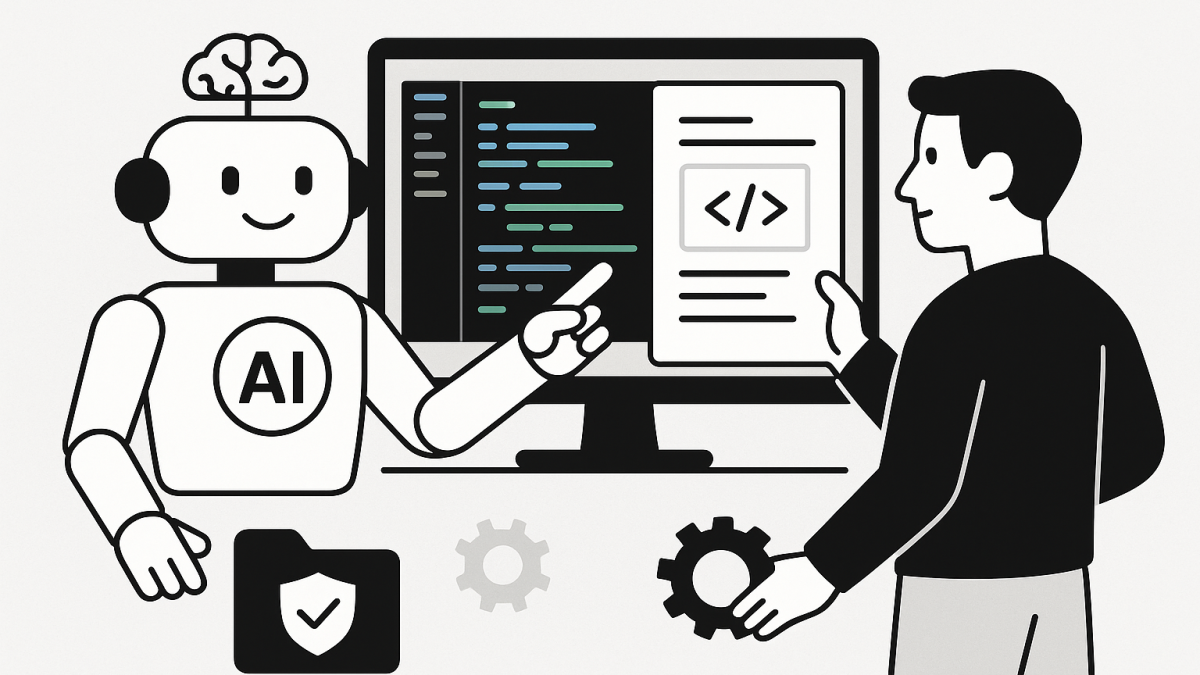
In this blog post OpenAI Codex and the New Enterprise SDLC for AI Assisted Coding we will explore what Codex is really changing inside enterprise software teams, why it feels different from earlier “AI pair programming”, and how to adopt it without creating new security and quality risks.
The biggest shift I’m seeing is simple to describe but hard to fully appreciate until you’ve lived through it: we’re moving from “AI suggests code” to “AI completes work”.
When Codex is used well, it behaves less like an autocomplete tool and more like a junior engineer who can take a ticket, make a branch, run tests, and propose a pull request for review. That changes the shape of the software development lifecycle (SDLC) in enterprise environments.
A high level view of Codex in enterprise terms
At a high level, Codex is an AI-powered software engineering agent. You give it an objective in plain language, it loads your repository context, makes changes across files, runs build and test commands, and returns a set of edits you can review.
That “agent” framing matters for business and technology leaders. You’re not just buying developer productivity. You’re introducing a new kind of digital worker into your engineering system that can change code, generate documentation, and influence architectural decisions at speed.
What’s under the hood (in plain language)
Most leaders don’t need model names to make good decisions, but they do need to understand the mechanics. Codex is built on large language models (LLMs) tuned specifically for software engineering tasks, and then wrapped in a controlled execution environment so it can actually do the work, not just talk about it.
1) The model understands patterns in code and intent
LLMs learn statistical patterns from large amounts of text, including code. In practice, that means Codex can infer developer intent from a ticket description, a failing unit test, a stack trace, or a set of existing conventions in your repository.
In my experience, the best results come when your codebase already has “strong signals”: clear module boundaries, consistent naming, a working test suite, and a predictable CI pipeline. Codex amplifies whatever discipline already exists.
2) The agent runs in a sandbox and uses tools
The real enterprise leap is tool use. Codex can execute commands, run tests, and iterate based on the results. That turns it into a loop: propose change → run checks → fix what failed → repeat.
This is also where governance becomes non-negotiable. If an AI agent can run commands, it can also do damage if guardrails are weak. The design pattern I recommend is “default deny, explicit allow” for anything that touches networks, secrets, or production-like environments.
3) It works asynchronously, like delegated work
Earlier tools trained people into a synchronous workflow: type, get suggestion, accept, repeat. Codex can be used that way, but its real value shows up when you delegate multiple well-scoped tasks in parallel and then review the output like you would review a teammate’s PRs.
That sounds like pure acceleration, and it can be. It also creates a new bottleneck: review capacity and decision-making discipline.
How AI powered coding is changing enterprise development
Here are the shifts I keep running into across organisations in Australia and internationally.
1) The unit of work shifts from “lines of code” to “reviewable change sets”
With Codex, the productivity conversation becomes less about typing speed and more about throughput of high-quality pull requests. That’s a healthier metric for enterprise delivery.
It also means your engineering leaders need to invest in the boring fundamentals: automated tests, meaningful CI checks, consistent linting, and a PR template that forces clarity about risk.
2) The SDLC becomes more parallel, but also more chaotic if unmanaged
Parallelism is great until it isn’t. If multiple agents produce changes across adjacent areas of a monolith, you can create merge conflicts, duplicated effort, and inconsistent approaches.
One pattern that works is to treat Codex like you treat humans: allocate ownership. Give each agent a bounded scope, a clear definition of done, and explicit constraints (what not to touch).
3) Architecture becomes an explicit prompt, not an implicit tribal memory
Enterprise architecture often lives in people’s heads and half-updated wiki pages. Agents force us to write it down, because the agent can’t reliably follow what isn’t expressed.
As a published author and an enterprise architect by background, I’m biased toward documentation that is short, current, and enforced by automation. Codex rewards that bias.
4) Quality risks shift from syntax errors to “confidently wrong” design choices
Codex can generate code that compiles and still violates your non-functional requirements: performance, privacy, resilience, supportability, or regulatory constraints.
That’s why I tell leaders: don’t ask “will it write secure code?” Ask “can we reliably detect when it didn’t?” Your controls matter more than its promises.
5) Security and compliance become workflow problems, not training problems
In Australia, frameworks like the ACSC Essential Eight push a pragmatic security posture: reduce attack surface, harden configurations, and improve detection and response. AI coding adds urgency to those basics.
If developers can generate more code faster, they can also generate more vulnerable code faster. The counterbalance is an SDLC that makes the secure path the easy path: secret scanning, dependency controls, SAST where it’s effective, and tight review gates on sensitive modules.
A real world scenario I’ve seen (anonymised)
A mid-sized organisation had a backlog of “important but not urgent” engineering hygiene work. Think dependency upgrades, small refactors, and test coverage improvements in a service that nobody wanted to touch.
They tried using AI as a code assistant before, but it mostly produced snippets that still needed heavy human assembly. The breakthrough came when they treated Codex as an agent and fed it disciplined tasks, one at a time, with a strict definition of done.
- Task 1: Upgrade a specific library within a single service, run unit tests, and update any breaking changes.
- Task 2: Add tests for a particular edge case that had caused incidents, and demonstrate the failing test before the fix.
- Task 3: Improve logging around a critical workflow, but keep logs free of personal data.
The outcome wasn’t “zero effort”. Engineers still reviewed every change. But the team moved from weeks of avoidance to a steady cadence of small PRs, each with evidence (test results) and a tight blast radius.
What impressed me wasn’t the speed. It was the psychological shift: the backlog stopped feeling like a swamp and started feeling like a checklist.
Practical steps for enterprise adoption (without the hype)
If you’re a CIO, CTO, or engineering leader thinking about Codex, these are the steps I’d take in order.
1) Start with “safe-to-try” categories of work
Pick tasks that are valuable but bounded. In my experience, the early wins come from:
- Adding or improving unit tests
- Documentation updates that reflect current behaviour
- Small refactors within one module
- Bug fixes with a reproducible failing test
- Migrations that are mechanical and easily validated
2) Make guardrails explicit (technical and process)
Define what the agent can access and what it can’t. Then enforce it.
- Limit repo scope where possible (least privilege, even for code)
- Prevent exposure of secrets (and assume prompts can leak them)
- Require approvals for network access and privileged commands
- Block direct production changes; route everything through PRs
3) Upgrade your review discipline, not just your tooling
If Codex increases output, your review system must scale. I recommend:
- Clear code ownership and CODEOWNERS rules for sensitive areas
- PR checklists that include security, privacy, and operability
- Smaller PRs with stronger evidence (tests, logs, benchmarks)
4) Treat prompts as artefacts
In teams that succeed, prompts evolve into reusable “work instructions”. They capture architecture constraints, naming conventions, and quality expectations.
Over time, this becomes part of your engineering system, like templates and standards. It also makes onboarding easier, because new developers can see how good work is specified.
5) Measure the right things
Typing speed is the wrong KPI. I’d track:
- Lead time from issue to merged PR
- Change failure rate and incident correlation
- Review turnaround time and rework rate
- Test coverage movement in risky modules
A small example of “agent-ready” task framing
The difference between success and frustration often comes down to how the work is framed. Here’s the kind of ticket/prompt structure that tends to work well:
// Goal
// Add protection against duplicate invoice submissions in the Payments API.
//
// Constraints
// - Do not change the public API contract.
// - Use existing persistence patterns in /src/payments.
// - Add unit tests that fail before the fix and pass after.
// - Ensure logs do not include customer PII.
//
// Definition of done
// - New tests added and passing.
// - Existing tests passing.
// - PR description explains approach and any trade-offs.
Notice what’s missing: a long architectural essay. It’s short, specific, and testable. That’s what agents thrive on, and it’s what good engineering thrives on too.
The leadership question Codex forces us to answer
I’ve spent 20+ years in enterprise IT across architecture, cloud, Microsoft 365, AI, and cybersecurity. Every few years a tool comes along that changes not just productivity, but responsibility boundaries.
Codex feels like one of those tools. It can accelerate delivery, but it also makes it easier to create complexity at speed if you don’t have a strong engineering system.
The question I’m sitting with is this: as AI agents become normal members of the delivery process, are we designing our SDLC to be resilient to fast change, or just faster at producing it?
