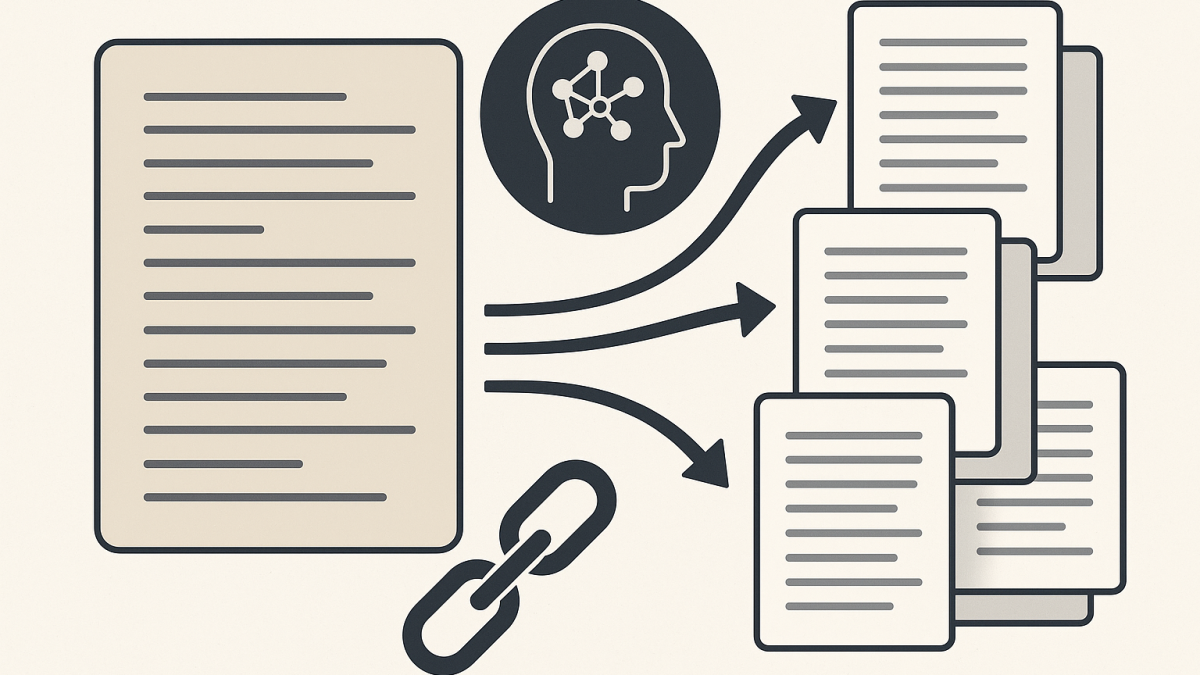
In this blog post Claude’s 200K Context Window Changes Enterprise Document Analysis we will explore why long-context AI is different from “just another chatbot”, and how I’ve seen it reshape document-heavy work in enterprise IT.
One pattern I keep running into with CIOs and architecture leaders is that the problem isn’t a lack of data. It’s the opposite. Policies, standards, contracts, runbooks, audit reports, and project documentation sprawl across SharePoint, Teams, wikis, PDFs, and email threads.
Claude’s 200K context window changes enterprise document analysis because it can hold a much larger slice of that sprawl in working memory at once. Less “please upload part 7”, less lost nuance between chunks, and fewer false conclusions caused by missing pages.
Let’s start high-level. A context window is the maximum amount of text the model can consider in a single request. That includes your prompt, the documents you paste or attach, and the model’s own output. When the context window is small, you’re forced to break documents into pieces. When it’s large, you can ask better questions because the model can see more of the evidence at once.
That shift sounds incremental. In practice, it changes the workflow. It moves AI from “summarise this page” to “reason across the whole pack”.
What a 200K context window actually enables
In my experience, long-context is most valuable when your documents are interdependent. Most enterprise documentation is. The truth is rarely in one file.
- Policies reference standards, which reference control objectives, which reference implementation guides.
- Contracts reference schedules, which reference SLAs, which reference exceptions.
- Architectures reference assumptions, which reference risk registers, which reference decisions that live in meeting notes.
With a larger context window, you can load a bigger portion of that chain and ask Claude to trace relationships, highlight contradictions, and produce structured outputs that are actually usable by humans.
The technology behind it, explained for leaders
Under the hood, models like Claude don’t “read” like we do. They work with tokens, which are pieces of text (not exactly words). A context window of ~200K tokens is roughly “hundreds of pages” depending on formatting and content density.
At inference time, Claude processes your entire input and uses an attention mechanism to decide what to focus on. With more context available, it has more raw material to attend to. That matters for tasks like comparing clauses, following definitions, and checking whether an exception is already covered elsewhere.
There’s a catch: more context doesn’t magically guarantee correctness. It reduces one major failure mode—missing information—while leaving others intact, like ambiguous writing, conflicting sources, or a question that needs domain decisions rather than text extraction.
Why this is a game changer in enterprise document analysis
1) Less chunking means fewer “analysis seams”
Chunking is where many “AI for documents” pilots quietly fail. You split a document, embed chunks, retrieve a few, and then ask the model to answer. That approach can work well, but it introduces seams.
The seams show up as missed definitions, incorrect precedence between documents, and answers that sound confident while ignoring the clause three pages earlier that changes everything.
A 200K context window doesn’t remove the need for retrieval in every case. But it lets you keep larger, coherent sections together: an entire policy plus its appendix, or a contract plus schedules A–D. That reduces accidental omission.
2) Better cross-document reasoning for governance and risk
When I help organisations map requirements to controls—whether that’s Essential Eight uplift, ISO-aligned control sets, or internal risk frameworks—the work is mostly about alignment and exceptions.
Long-context is particularly good at producing a first pass mapping like:
- Requirement statement
- Where it is (document, section, excerpt)
- What evidence is missing
- What contradicts it elsewhere
For Australian organisations, the practical win is speed-to-clarity. You can move from “we think we comply” to “here’s what we can point to, and here’s what we can’t”.
3) Higher quality summaries because the model can keep caveats intact
Executives don’t want 80 pages. They want a one-page brief. The danger is that summaries erase the caveats that keep you safe.
With more context, Claude can summarise while still preserving edge conditions like:
- “This applies to production systems only.”
- “Except for legacy platforms under transition.”
- “Within 30 days, unless approved by the security lead.”
Those qualifiers are often scattered. Longer context makes it easier to keep them in view while writing the summary.
4) More useful structured outputs for implementation teams
In enterprise IT, the output that matters is rarely prose. It’s artefacts: control checklists, test cases, acceptance criteria, migration runbooks, and decision records.
Long-context enables “generate from the pack” workflows. For example:
- Build a gap register from policy + standard + current-state evidence.
- Generate implementation tasks tagged by platform (Azure, Microsoft 365, on-prem).
- Create audit-ready narratives with evidence references for each claim.
That’s where I see real value: not replacing architects, but accelerating the tedious synthesis steps that drain attention from actual design and risk judgement.
A real-world scenario I’ve seen (anonymised)
A mid-sized Australian organisation had a familiar situation. Security wanted improved governance. IT was modernising Microsoft 365 and expanding Azure. Everyone agreed on the destination, but the documentation was inconsistent and out of date.
They had:
- An information security policy updated recently.
- A technical standard written years earlier.
- Project documents describing “how we do it now”.
- Exception approvals living in email and meeting notes.
We used Claude with a long-context approach to load the policy, the standard, and a curated evidence pack (exported artefacts and current configuration summaries). The goal wasn’t “tell us if we’re compliant”. It was to produce a reviewable mapping: where the documents agree, where they contradict, and what decisions were implicit rather than explicit.
What changed was the conversation. Instead of debating opinions, leaders debated specific text. We could point to where a standard required something that the policy never mentioned, and where the current environment was doing something reasonable but undocumented.
The outcome wasn’t a magic compliance stamp. It was a prioritised remediation plan that engineering could execute, plus a policy refresh backlog that governance could own.
Practical steps to use 200K context effectively
Step 1: Curate the pack (don’t just dump everything)
Even with long-context, more isn’t always better. I’ve had better results by curating a pack with clear scope boundaries.
- Include the authoritative documents (policy, standard, contract).
- Add only the evidence relevant to the question.
- Remove duplicates and superseded versions where possible.
Step 2: Ask for outputs that can be audited
For enterprise use, “trust me” answers aren’t enough. Ask Claude to produce traceable outputs: a table with section references, a list of assumptions, and explicit uncertainty where the text is silent.
Example prompt pattern:
You are analysing an enterprise policy pack.

Task:
1) Identify requirements related to privileged access, patching, and macro controls.
2) For each requirement, quote a short excerpt (max 2 sentences) and record the document + section title.
3) List contradictions or ambiguity.
4) Produce a gap list of what is NOT specified but is implied by common practice.

Output as a table plus a short narrative summary for executives.
Step 3: Keep a “decision log” in the same context
One simple trick: keep a running decision log as you refine outputs. When the model can see the decisions you’ve already made, it stops re-litigating the same debates.
- What scope are we analysing?
- What terms mean what in this organisation?
- Which document wins on precedence when they disagree?
Step 4: Treat it as a co-pilot, not an authority
I’m an AI practitioner and I’m optimistic about where this is going. But for governance, legal, and security work, I still treat the model as a fast analyst that drafts artefacts.
Humans still need to validate, especially where Australian regulatory obligations, privacy expectations, and organisational risk appetite come into play.
Where long-context still struggles
It’s worth being honest about limitations I’ve seen in real projects.
- Contradictory documents can produce plausible-but-wrong synthesis unless you explicitly ask it to surface conflicts.
- Vague writing leads to vague answers. The model can’t create governance clarity that the organisation hasn’t decided.
- Token budget trade-offs still exist. If you load the entire pack, you may have less space for iterative Q&A and detailed outputs.
The right mindset is: long-context reduces friction, not accountability.
My takeaway
After 20+ years working as a Solution Architect and Enterprise Architect across Azure, Microsoft 365, cybersecurity, and AI, I’ve learnt that most “enterprise transformation” is really “enterprise alignment”. The hard part is getting everyone to agree on what the documents actually say, what they imply, and what they forgot to mention.
Claude’s 200K context window meaningfully improves that alignment step. It turns document analysis from a manual, brittle process into something closer to an iterative working session—faster, more structured, and easier to validate.
The question I’m thinking about now is this: as context windows keep expanding, will we finally stop writing documents for storage and start writing them for continuous analysis and decision-making?
