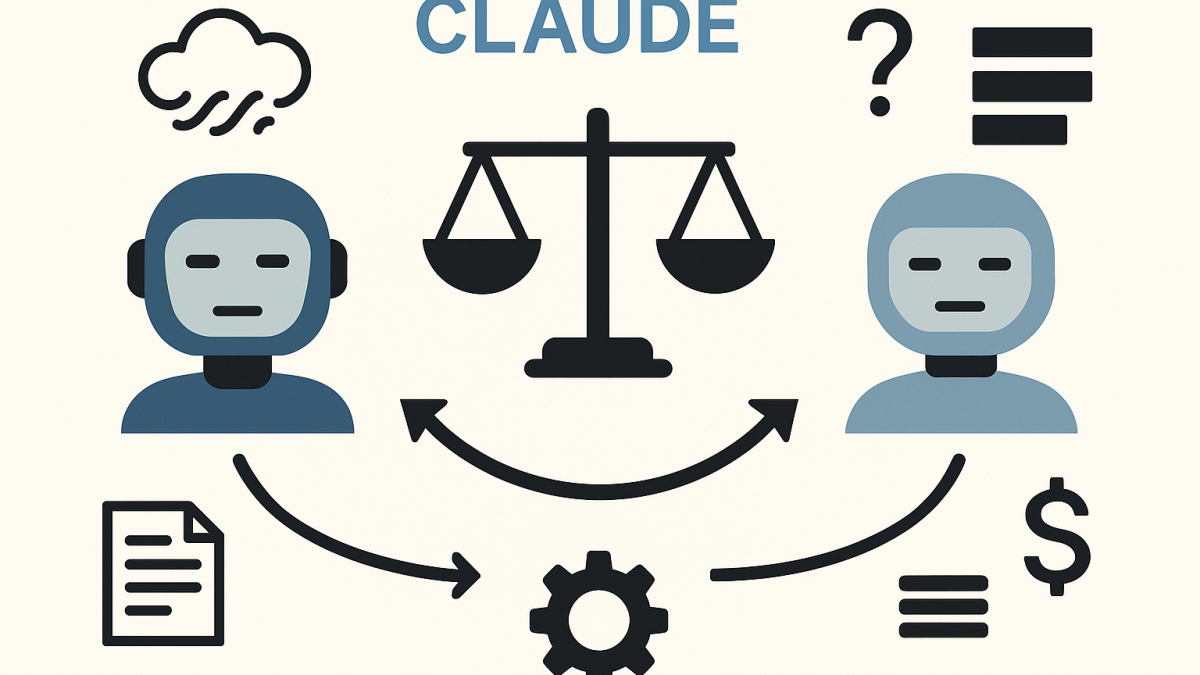
In this blog post Claude Opus 4.5 vs Claude Sonnet 4.5 Which One Fits Your Use Case we will break down what these two models are actually good at, where they fail in the real world, and how I decide which one to put into production.
I keep seeing the same pattern in enterprise AI programs: teams pick a model the way they pick a laptop—“get the best one”—and then wonder why costs spike, latency becomes painful, or developers quietly stop using it. Claude Opus 4.5 vs Claude Sonnet 4.5 Which One Fits Your Use Case is really a question about operating AI inside a business, not just admiring benchmark charts.
I’m based in Melbourne and work across Australian and international organisations. I’ve been in Solution Architect and Enterprise Architect roles for 20+ years, and I’m also a published author. My bias is practical: if it doesn’t survive security review, procurement reality, and day-two operations, it’s not “enterprise-ready.”
High-level first: what you’re choosing between
Think of Opus 4.5 and Sonnet 4.5 as two “grades” of the same capability. Both can draft, reason, code, and summarise. The difference is how far you can push them before they get sloppy, slow, or expensive.
In plain terms, Opus 4.5 is the model I reach for when the problem is ambiguous, multi-step, and high-impact. Sonnet 4.5 is the model I use when we need strong performance at scale, predictable cost, and fast iteration across many workflows.
The technology behind it (without the fluff)
Both Opus and Sonnet are large language models (LLMs). They predict the next token (a chunk of text) based on your prompt and the conversation history. That sounds simple, but the business impact comes from how we structure prompts, control context, and constrain outputs so the model behaves like a reliable system component.
Three technical ideas matter most in practice.
- Context window: how much information the model can “see” at once (documents, code, prior messages). Bigger context enables richer reasoning over large artefacts, but it can also increase cost and complexity.
- Tool use (function calling): the model can call external tools (search, database lookup, ticket creation, policy retrieval) and then reason over results. This is how we turn an LLM from “chat” into an agentic workflow.
- Prompt caching: you can reuse expensive, repeated context (like policies, architecture standards, or a codebase summary) so each request doesn’t pay full price again. This is one of the biggest levers for enterprise cost control.
If you only remember one thing: most “model selection” problems are actually architecture problems. The right model plus the wrong context strategy is still the wrong solution.
The practical differences that matter to a business
1) Reliability under ambiguity (Opus usually wins)
When requirements are messy, stakeholders disagree, and the input is incomplete, I’ve found Opus-class models tend to hold a stronger line. They are more likely to ask better clarifying questions and maintain coherence across a long chain of reasoning.
This matters for things like architecture options analysis, incident postmortems, risk assessments, and “what should we do next?” planning—where a confident but wrong answer is more dangerous than “I need one more input.”
2) Cost-to-value at scale (Sonnet usually wins)
Sonnet 4.5 is often the better default for day-to-day engineering and IT workflows: drafting change requests, summarising tickets, generating runbooks, writing internal comms, producing first-pass code, and doing structured transformations (CSV to JSON, policy to checklist, and so on).
The reason is simple: you can run far more Sonnet calls for the same budget envelope. In real programs, you want lots of small wins across teams, not one perfect answer that only a few people can afford to use.
3) Long-context work (Sonnet has a strong edge when you truly need it)
Long context is not a party trick. It’s what makes “read a large design pack and find contradictions” or “reason across a large repo” feasible.
But it comes with a governance problem: the moment you allow huge prompts, you invite data sprawl. That’s where Australian context matters—privacy obligations, retention requirements, and the practical reality of security teams mapping AI usage to internal controls and frameworks like the Essential Eight.
My rule: only enable long-context when you can explain, in one sentence, what business outcome it enables that smaller context cannot.
4) Agent workflows (both can do it, but I assign roles)
In agentic systems, I rarely use a single model for everything. I assign roles:
- Sonnet as the “operator”: executes repeatable steps, calls tools, gathers evidence, formats outputs, updates tickets.
- Opus as the “reviewer”: handles the hard judgment calls, resolves conflicts, and produces the final recommendation when stakes are high.
This split is how you keep costs sane while still getting the quality you want when it matters.
A simple decision framework I use
When a team asks me “Which one should we standardise on?”, I push back gently. Standardise on a routing policy, not a single model.
Step 1: Classify the workload by risk
- Low risk: internal drafts, summaries, formatting, first-pass code, test generation.
- Medium risk: customer-facing text with human review, non-prod automation, analytics narratives, runbook recommendations.
- High risk: security decisions, production changes, compliance interpretations, contractual language, sensitive personnel matters.
My default mapping: Sonnet for low/medium; Opus for high risk or high ambiguity.
Step 2: Decide if you need long context or not
If the prompt routinely grows beyond “a few pages of text,” treat context as a design constraint. Summarise, chunk, retrieve, and cache. Don’t just dump more tokens in and hope for the best.
Step 3: Put a price on latency
Leaders often forget that time is a cost. If developers wait longer, they stop using the tool. In my experience, adoption is far more sensitive to latency and friction than to “model IQ.”
Sonnet is typically the better fit where responsiveness drives usage: IDE assistance, operational chat, ticket triage, and rapid iteration loops.
Step 4: Design for fallback and verification
For enterprise safety and predictability, I like a two-pass pattern.
- Pass 1 (Sonnet): produce the draft + evidence list + assumptions.
- Pass 2 (Opus): challenge assumptions, spot gaps, and tighten the final answer.
You can also flip it for high-stakes work: Opus drafts; Sonnet operationalises into tasks and templates.
A real-world scenario I’ve seen (anonymised)
A mid-sized Australian organisation wanted to speed up security and change management documentation. They had an existing Microsoft 365 estate, a growing Azure footprint, and a security team aligned to Essential Eight maturity uplift.
The first attempt used the “best model” for everything. It produced beautiful documents, but it was slow and expensive, and it created a subtle compliance risk: people started pasting whole incident notes and technical logs into the chat because it “worked.”
We redesigned it as a workflow.
- Sonnet handled structured transformations: turning tickets into consistent summaries, extracting action items, drafting change templates, and generating first-pass runbooks.
- Opus was used selectively: risk narratives, executive summaries, and security exceptions—where nuance and trade-offs mattered.
- We added retrieval and caching so policy and standards content didn’t get re-sent every time.
The outcome wasn’t just lower cost. The bigger win was behavioural: people stopped treating the model like a dumping ground and started treating it like a controlled system with guardrails.
Concrete recommendations by persona
For CIOs and CTOs
- Don’t debate “Opus vs Sonnet” in the abstract. Ask which workloads you are enabling and what your acceptable risk is.
- Insist on a routing strategy and usage telemetry from day one. The fastest way to lose trust is surprise bills and inconsistent outputs.
- Invest in data controls: what can be pasted, what must be redacted, what stays in-country, what is retained. Model choice won’t save you from governance gaps.
For IT directors and platform owners
- Design for day-two: prompt versioning, environment separation, logging, and reproducibility.
- Use Sonnet for “platform scale” tasks (high volume, predictable patterns). Reserve Opus for “platform judgment” tasks.
- Build a library of approved prompts for repeatable outcomes: change summaries, incident reports, service health updates.
For developers and engineering leads
- Use Sonnet as your default copilot. Use Opus when you’re stuck, when the bug is non-obvious, or when you need a deeper design refactor.
- Get serious about context hygiene. Provide minimal reproducible examples, not entire repositories pasted into a chat.
- Ask the model to output its assumptions and a verification checklist. This reduces “silent wrongness.”
Practical implementation pattern (routing in code)
Below is a simple pattern I’ve used: route by risk, then fall back if needed. This isn’t about being fancy—it’s about being intentional.
// Pseudocode for model routing
function chooseModel(task) {
 if (task.risk === "high" || task.ambiguity === "high") return "claude-opus-4.5";
 if return "claude-sonnet-4.5";
 return "claude-sonnet-4.5";
}

function generateAnswer(task) {
 const model = chooseModel(task);
 const draft = callModel(model, task.prompt);

 // Optional: second-pass review for medium/high impact outputs
 if {
 const reviewPrompt = buildReviewPrompt(task, draft);
 return callModel("claude-opus-4.5", reviewPrompt);
 }

 return draft;
}
The biggest upgrade here is not the if-statement. It’s the organisational decision that “some outputs get a second set of eyes,” and that the second set of eyes can be a different model.
So which one should your business actually use?
If you force me to pick one default, I usually start with Sonnet 4.5. It’s strong, scalable, and makes it easier to put AI into more hands without turning every workflow into a premium experience.
But I would never run an enterprise program without Opus 4.5 available for the moments that matter: complex incidents, thorny architecture trade-offs, security exception reasoning, and the “we need a clear direction by tomorrow” kind of work.
My forward-looking view is that the winning organisations won’t be the ones who picked the “smartest model.” They’ll be the ones who built the best operating system around models—routing, verification, governance, and a clear understanding of where AI adds value versus where it adds risk.
If you looked at your current AI usage, how much of it is true decision support—and how much is just expensive autocomplete?
